Trump declassifies emails showing NSA analysts “massaged” 2020 election intelligence
Trump declassified DNI and NSA emails from November 2020 show analysts worried they were steering a President's Daily Brief “away from elections,” a document Trump released on July 3, 2026.
WASHINGTON D.C. — Donald Trump has released declassified intelligence emails alleging analysts steered a President’s Daily Brief away from the 2020 election.
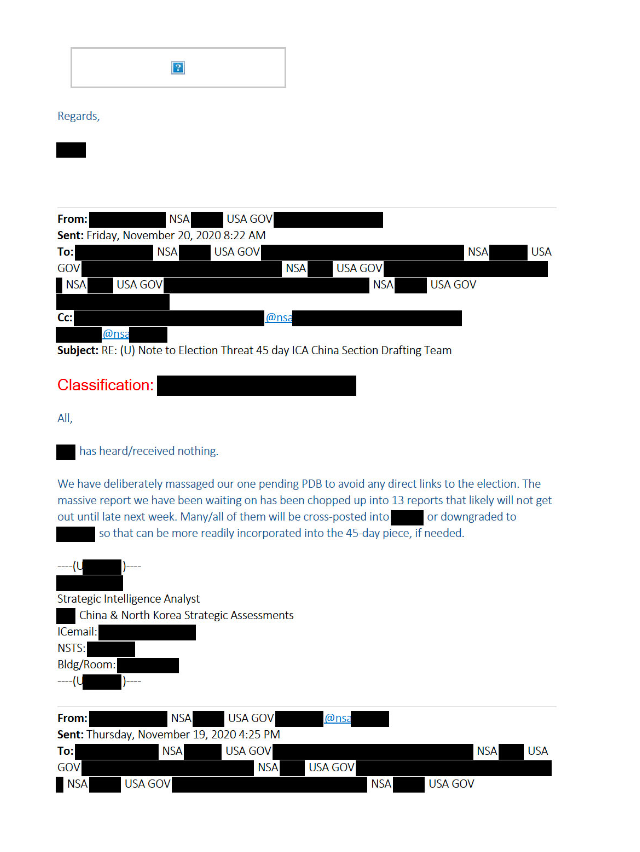
Here is the full post on truthsocial: “Regards, From: ? NSA USA GOV Sent: Friday, November 20, 2020 8:22 AM To:/ NSA GOV NSA USA GOV Cc: @nsa USA GOV NSA USA NSA USA GOV NSA USA GOV @nsa Subject: RE: (U) Note to Election Threat 45 day ICA China Section Drafting Team Classification: 1 All, | has heard/received nothing. We have deliberately massaged our one pending PDB to avoid any direct links to the election.”
The shared images show a redacted email chain marked “DECLASSIFIED BY PRESIDENT TRUMP on 3 July 2026.” One message, sent Friday, November 20, 2020 at 8:22 AM ET, states that analysts “deliberately massaged our one pending PDB to avoid any direct links to the election.” The same message reported that a large report was “chopped up into 13 reports” tied to a 45-day Intelligence Community Assessment on China. A signature block identifies the author as a “Strategic Intelligence Analyst” working on “China & North Korea Strategic Assessments.”
A second image shows Director of National Intelligence correspondents debating the same document days later. One writer flagged concern “as to why they are “deliberately massaging” analysis away from elections,” while another wrote, “I’m not sure what to make of this.” Those exchanges, dated Monday, November 23, 2020, referenced a 30 November deadline for the ICA draft.
The President’s Daily Brief is the intelligence community’s most sensitive product for the president. The National Security Agency conducts communications surveillance and processes signals intelligence data, according to ebsco.com. The 45-day report reflects an executive-order requirement that intelligence agencies assess foreign election interference after a federal vote.
The stakes reach the credibility of the intelligence community and the winners or losers of a lasting dispute over 2020. Supporters of the release argue the emails validate longstanding claims that career officials shaped assessments for political effect. Critics counter that heavy redactions obscure who wrote each line and strip away context, leaving the phrase “deliberately massaging” open to interpretation.
Controversy over intelligence and elections is not new. Edward Snowden, a former NSA contractor, leaked classified documents in June 2013 that exposed bulk collection of telephone and internet data, according to ebsco.com. That disclosure ignited a global debate over privacy and government transparency. The backlash produced legal challenges and legislative reform tied to the Foreign Intelligence Surveillance Act, according to nsa.gov.
For the average reader, the fight bears on trust in the agencies that assess threats to their vote. Watchdog groups have long pressed for stronger oversight of secret surveillance authorities, according to aclu.org and brennancenter.org.
Has this happened before? This has happened before, though rarely at this level of exposure. Government watchdogs have documented internal disputes over how intelligence products are framed and released, according to pogo.org. Still, a sitting president publicly declassifying an internal NSA-DNI email chain about a domestic election remains uncommon.
The next decision rests with the Office of the Director of National Intelligence and the National Security Agency, which could release additional material or fuller versions of the redacted chain. No date for any further release has been announced.
Presidents wielding the declassification power to settle political scores isn’t the first time secrecy has collided with politics. In 1971, the Pentagon Papers, a 7,000-page classified study of the Vietnam War, reached the public after a leak. The Supreme Court ruled 6-3 on June 30, 1971 that the government could not block publication. That fight reshaped how Washington treats classified records, and the official at its center, Defense Secretary Robert McNamara, saw his war assessments scrutinized for decades afterward.
NewsFindr Chart Maker
Zenger analysis
OpenTopoMap / Natural Earth – China
OpenTopoMap / Natural Earth – North Korea
OpenTopoMap / Natural Earth – Vietnam


