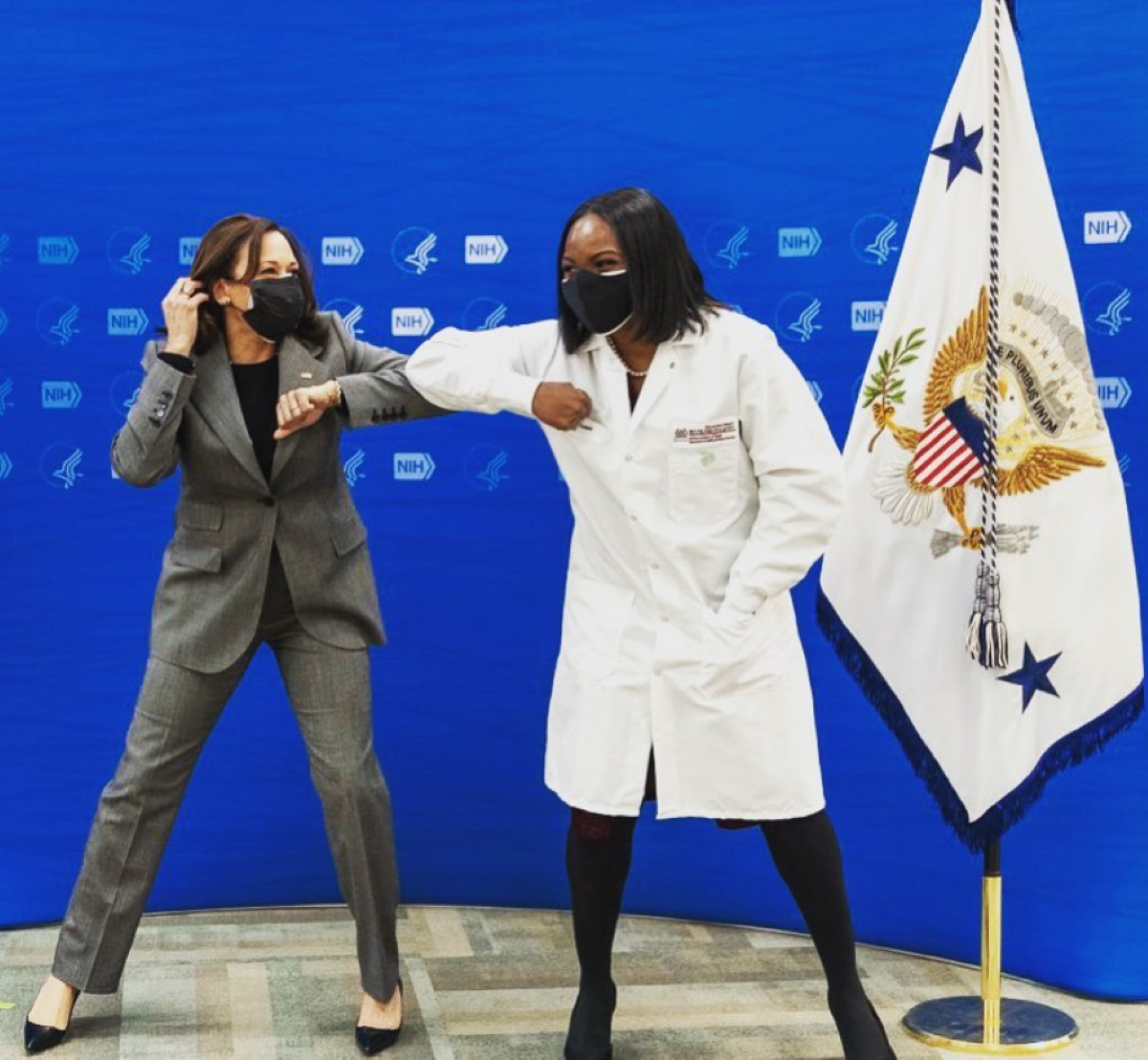
The Scientist Preparing Humanity for Future Pandemics
Kizzmekia Corbett-Helaire, advancing research on broader vaccines that would strengthen global preparedness for the next pandemic

CALIFORNIA CITY, CALIFORNIA — Every scientist has a beginning. Kizzmekia Corbett was a curious student who had early exposure to research and mentorship, which shaped her into immunology. While in high school, she spent her summer holiday working in a research laboratory under a sponsored program called Project SEED as part of the American Chemical Society, a society in the United States that supports scientific inquiries in the field of chemistry. In 2005,he worked in Gloria Viboud’s lab at Stony Brook University as an intern. During that summer period she learned Yersinia pseudotuberculosis pathogenesis.
For Corbett, one research opportunity led to the other; the early experience ignited a passion in her that did not fade. In 2006 and 2007, she expanded her laboratory experience by working as a lab tech in Susan Dorsey’s lab at the University of Maryland School of Nursing. After four years of her bachelor’s, she became a biological sciences trainer at the National Institutes of Health.
Corbett expanded her research on the dengue virus mainly to discover the human antibody response to the virus in Sri Lankan children under the supervision of Aravinda de Silva between 2009 and 2014. As part of her research for her dissertation, Corbett-Helaire worked as a visiting scholar at the Genetech Research Institute in Colombo, Sri Lanka, from April to May 2014, and she got her PhD.
Finally, she got a career-defining opportunity as a research fellow. She became a viral immunologist at the NIH under Barney S. Graham, whom she had worked with back when she started as a trainer.
Before the COVID-19 pandemic, Corbett’s team already had knowledge of optimal coronavirus proteins. So she’s a lady who’s always ahead indeed. They had previously published work in the Proceedings of the National Academy of Sciences (a peer-reviewed multidisciplinary scientific journal). It detailed the method of stabilizing coronavirus spike proteins in their prefusion conformation using two proline (2P) amino acid substitutions.
Born on January 26, 1986, to Rhonda Brooks Corbett, Helaire grew up in Hillsborough, North Carolina. She had a big family of step-siblings and foster siblings. She attended Oakane Elementary School in Roxboro and A.L. Stanback Middle School in Hillsborough. Furthermore, she later graduated from Orange High School, North CaroliFurthermore, she in 2004. She earned her bachelor’s (2008) under the Meyerhoff Scholarship program in biological sciences and PhD in microbiology and immunology from the University of Maryland Baltimore County and the University of North Carolina at Chapel Hill, respectively. A journey that birthed skills to prominence in biomedicine during the COVID-19 outbreak. The back-to-the-2P mutations, which prevent the spike protein from collapsing before it can trigger an immune response, were incorporated into other COVID-19 vaccines, including Pfizer-BioNTech’s BNT162b2. Kizzmekia is currently serving as an assistant professor of immunology and infectious diseases at Harvard T.H. Chan School of Public Health.


Repeated vials with the COVID-19 vaccine in Colgone,Germany on January 20, 2021 at 9:33 AM. Photo: Yulia Reznikov/Getty images. © Getty images
Viruses evolve faster than vaccines can be developed; the COVID-19 pandemic demonstrated this. Today, Corbett-Helaries faces the challenge to develop broader vaccines that could protect against future pandemics before they become a global crisis. Kizzmekia Corbett-Helaire‘s team at Harvard mainly focuses in the lab on coming up with novel vaccines in preparedness for a pandemic. They do this by learning how the human system responds to coronavirus spike proteins. They also map the coronavirus strain that is common and causes common cold-like symptoms.
“[The pandemic revealed both the strengths and weakness of our system.Decades of investment in genomics and vaccine platforms allowed us to move at unprecedented speed. But it is also showed how fragile public trust can be, and how inequalities in health care magnify crises. The bigger picture is that science can deliver miracles, but only if society is prepared to listen,invest, and ensure benefits reach everyone, Collins]”
“[The stabilization of the spike protein was the turning point. The single breakthrough made rapid vaccine design possible and will accelerate responses to future respiratory viruses]”
How do you convince the public to trust science while preparing for a pandemic? In Cobertt’s research, her greatest legacy will be a vaccine that helped end both a pandemic and the pandemic the world never had to face.