
Trump Allies Push New Tariff Weapon to Punish Trade Deficit Nations
Trump backs a Senate bill by Rick Scott that would grant him congressional authority to impose duties on countries running trade deficits with the United States.

WASHINGTON D.C. — Donald J. Trump promoted a Senate push to hand him sharper tariff powers against countries running trade deficits with the United States, days after the Supreme Court struck down his universal duties.
The Trade Deficit Elimination Act, led by Sen. Rick Scott, R-Fla., would create a congressional framework letting the president impose duties on nations that carry longstanding trade imbalances with America, according to foxnews.com. The bill would build a new authority under Article 1, Section 8, separate from the emergency law the court rejected.
“That means we can’t let other countries rip us off,” Scott said in a statement to Fox News Digital, defending the measure as a way to hold trading partners accountable.
The move matters because it would restore tariff tools the White House lost in court. It would give the administration a durable legal basis to pressure foreign governments over trade gaps that touch prices, supply chains and factory jobs across the country.
Here is the full post on truthsocial: “Trump allies push to arm president with new tariff weapon to punish countries “ripping off” America: https://www.foxnews.com/politics/trump-allies-push-arm-president-new-tariff-weapon-punish-countries-ripping-off-america” on August 6, 2026 at 4:38 PM ET.
This is Trump’s 12th message released today, and the last post was 32 minutes ago, and it is not part of a thread. On average, Trump produces 18 posts per day since his inauguration on January 20, 2025. The move fits a broader pattern in Trump’s recent messaging, with 10 of his 464 posts over the last 30 days classified as tariff posts. Trump shared the report by mentioning the source (see foxnews).
Scott’s bill would require U.S. Trade Representative Jamieson Greer to compile an annual watch list of nations labeled “trade deficit economies,” according to foxnews.com. From that list, the president could impose, increase, decrease, suspend or modify tariffs to eliminate bilateral goods trade deficits. The bill exempts certain products deemed critical to U.S. supply chains, national security, or where alternative sources are unavailable. Sens. Kevin Cramer, R-N.D., and Tim Sheehy, R-Mont., signed on as co-sponsors.
The stakes divide cleanly. Domestic manufacturers, farmers and ranchers stand to gain leverage if the president can target trade partners without fresh legal challenges, while importers and consumers could absorb higher costs on goods that carry new duties. Foreign exporters running surpluses with the United States would face the sharpest exposure.
The legal backdrop drives the timing. Trump issued his “liberation day” tariffs under the International Emergency Economic Powers Act, but the Supreme Court ruled this year that he lacked the authority to do so, according to foxnews.com. The announcement came a day after the administration refunded $100 billion in tariff revenue collected during that earlier campaign.
The scale rivals major federal outlays. A $100 billion refund exceeds the annual budgets of many U.S. states and dwarfs the yearly revenue of most Fortune 500 companies.
For the average reader, the fight could reshape sticker prices on imported cars, electronics and clothing, while also determining whether some factory work returns to American plants.
Congress has clashed with the executive over tariff authority before. Lawmakers granted the president broad trade powers through statutes dating back decades, and courts have policed the limits, as the recent Supreme Court ruling showed.
The next move rests with the Senate Finance Committee and the House Ways and Means Committee, which would consult on any duties, according to foxnews.com. A date for a floor vote on the Trade Deficit Elimination Act has not been announced.
Congress arming a president against foreign commerce has deep roots in American history. Lawmakers passed the Tariff Act of 1930, known as Smoot-Hawley, raising duties on more than 20,000 imported goods to record levels, according to britannica.com. Trading partners retaliated, U.S. exports and imports fell by more than half within four years, and the measure deepened the Great Depression. President Herbert Hoover, who signed it over the protest of more than 1,000 economists, lost the White House two years later in a landslide.
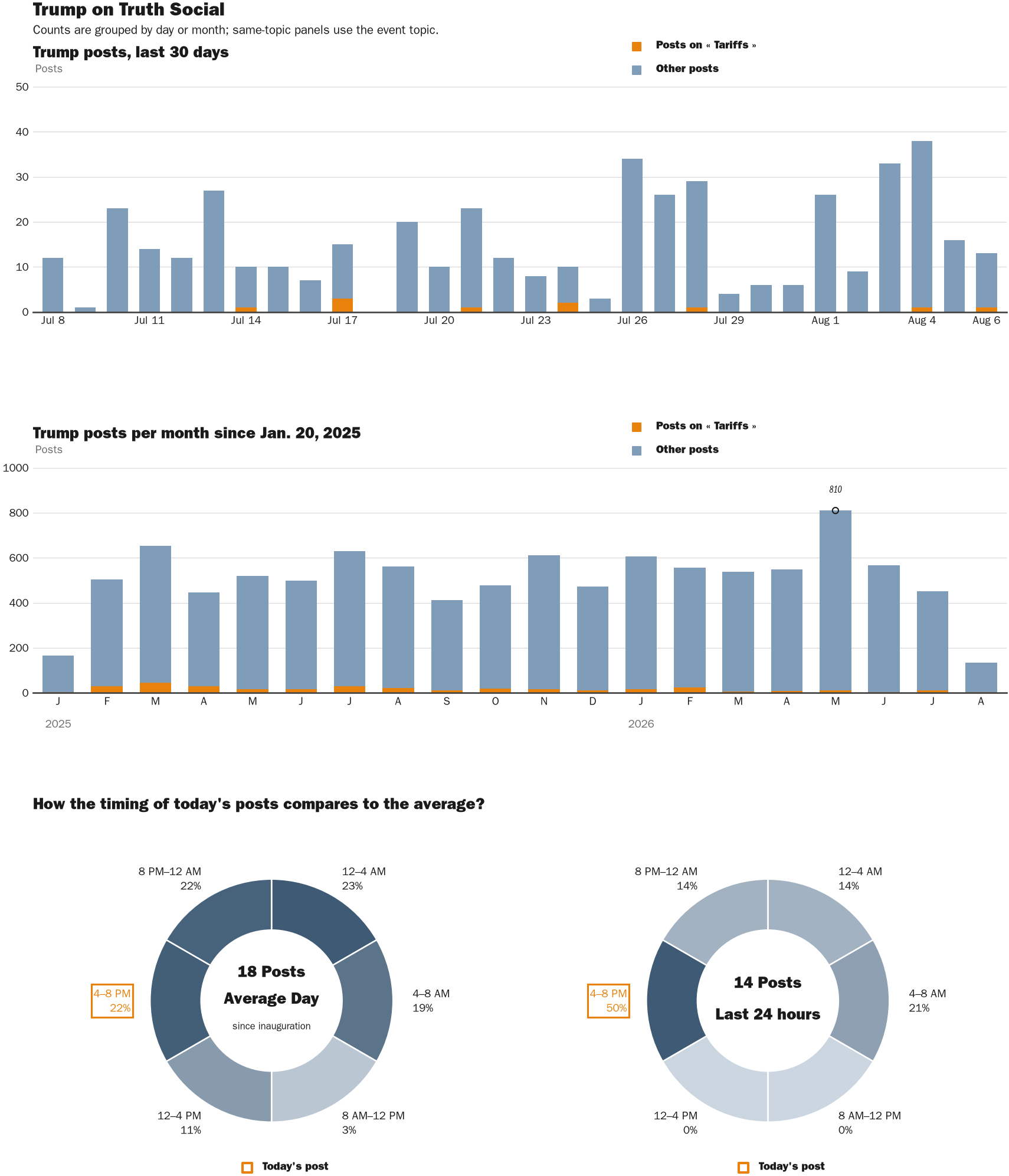

NewsFindr Chart Maker
Photo by Zenger real-time database of all Truth Social posts.
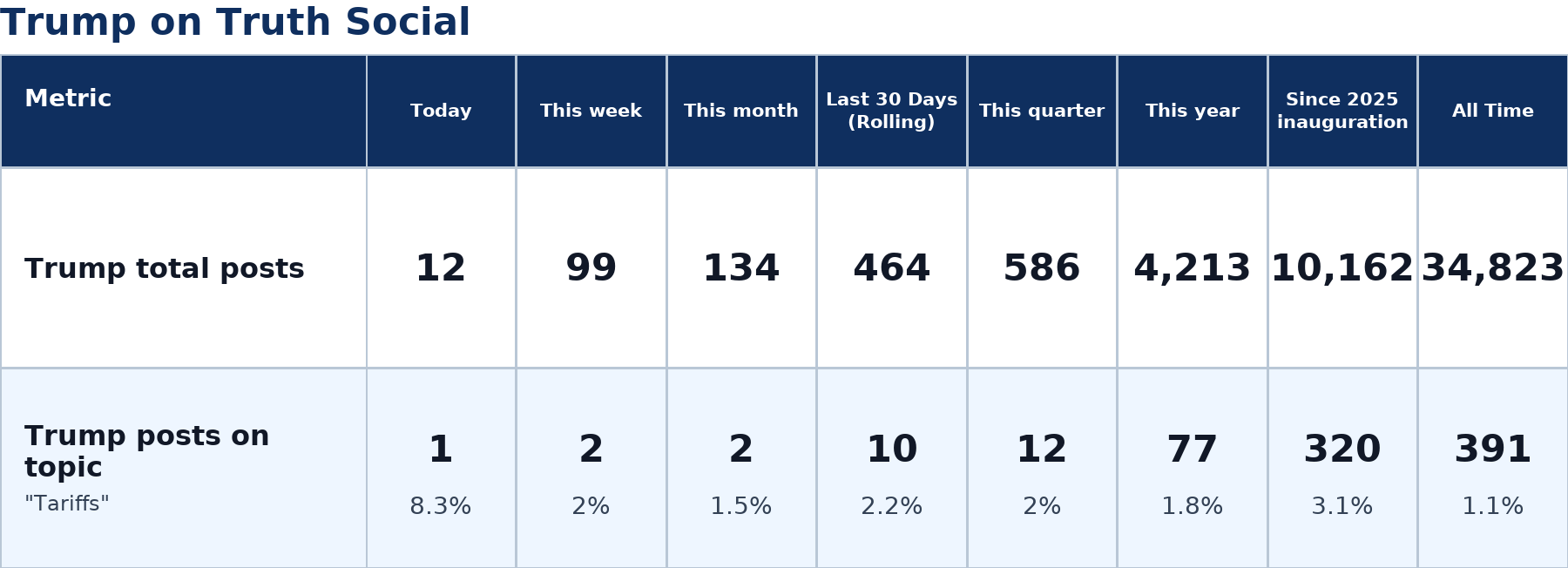
Zenger analysis
Photo by Zenger analysis