Trump Amplifies Johnson’s Call to End Senate Filibuster
Trump shares a Wall Street Journal opinion piece by Sen. Ron Johnson urging Republicans to scrap the 60-vote threshold before Democrats do, citing a $39 trillion debt and years of stalled appropriations.

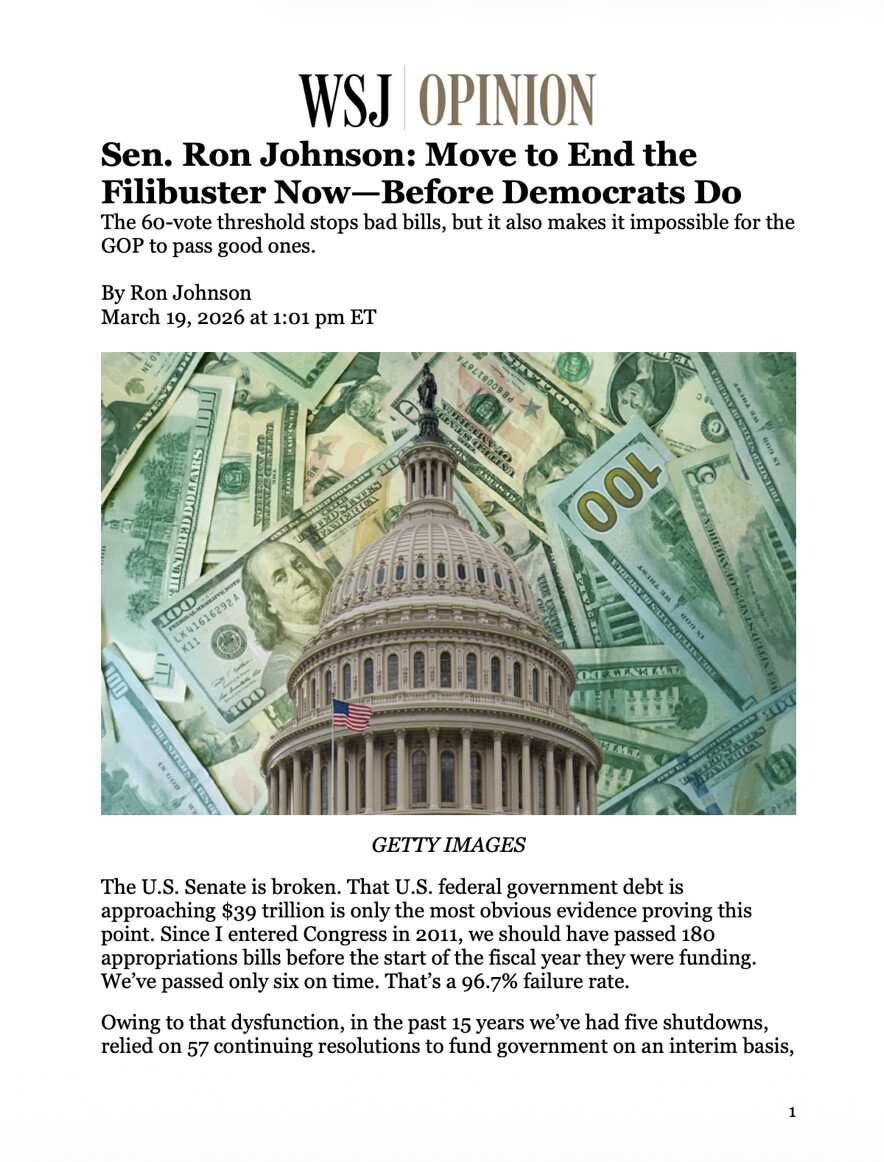
WASHINGTON D.C. — Donald J. Trump amplified a call to abolish the Senate filibuster, sharing a Wall Street Journal opinion piece that urges Republicans to act before Democrats do.
The article, written by Sen. Ron Johnson, the Wisconsin Republican who now chairs the Senate Budget Committee, argues that the 60-vote threshold blocks legislation the public supports. Johnson tied his case to a federal debt approaching $39 trillion and a record of legislative gridlock, according to wsj.
“The U.S. Senate is broken,” Johnson wrote in the piece, adding that lawmakers have passed only six of 180 appropriations bills on time since 2011, a failure rate he put at 96.7%.
For a general reader, the filibuster shapes whether a Senate majority can enact its agenda or must negotiate with the minority. Ending it would let 51 senators pass bills on spending, immigration and elections that now stall, raising the stakes of every Senate election.
Here is the full post on truthsocial: “Sen. Ron Johnson: Move to End the Filibuster Now—Before Democrats Do” on July 27, 2026 at 4:24 PM ET.
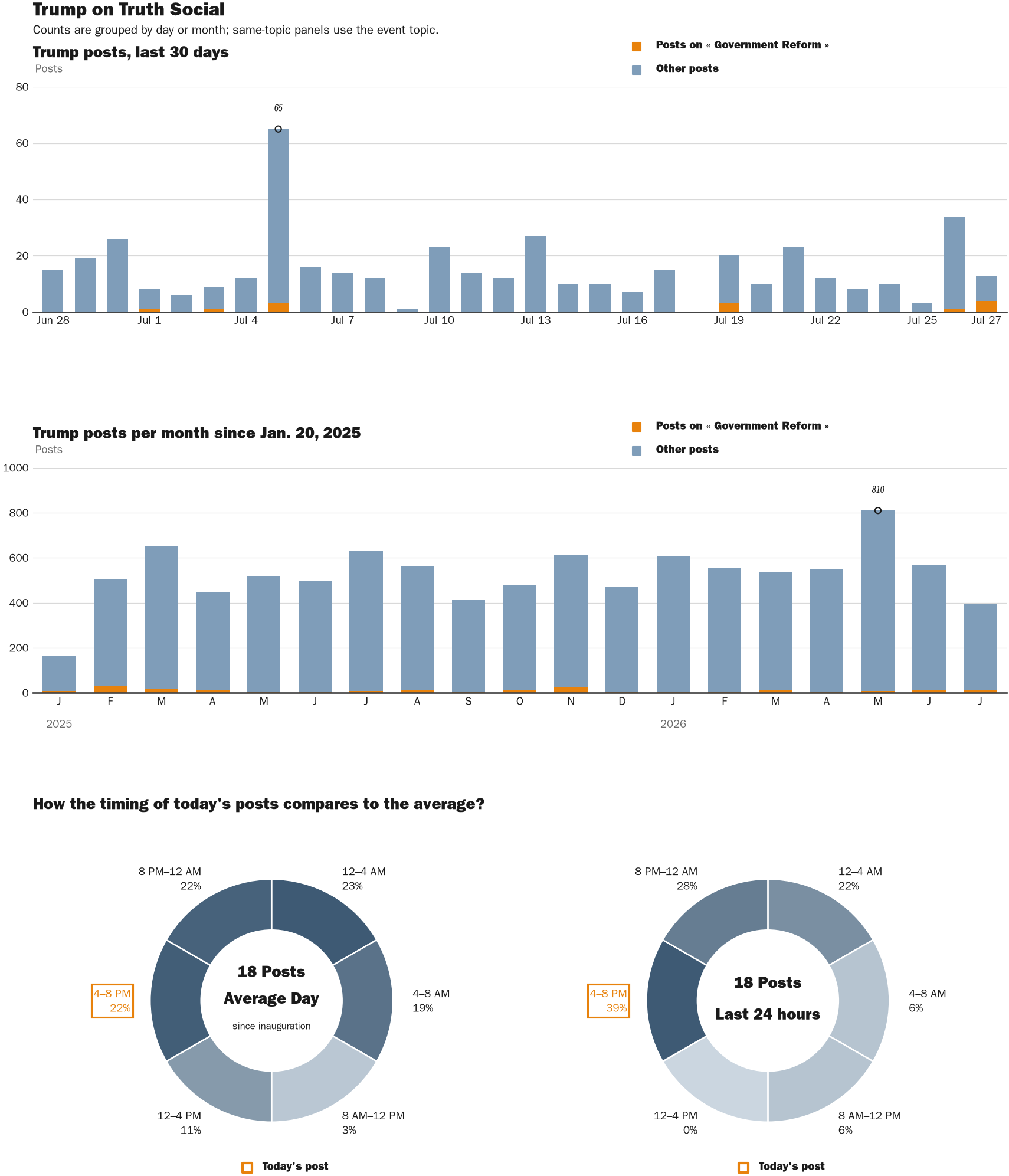
This is one of many messages released by Trump today. On average, Trump produces about 15 posts per day since his inauguration on January 20, 2025.
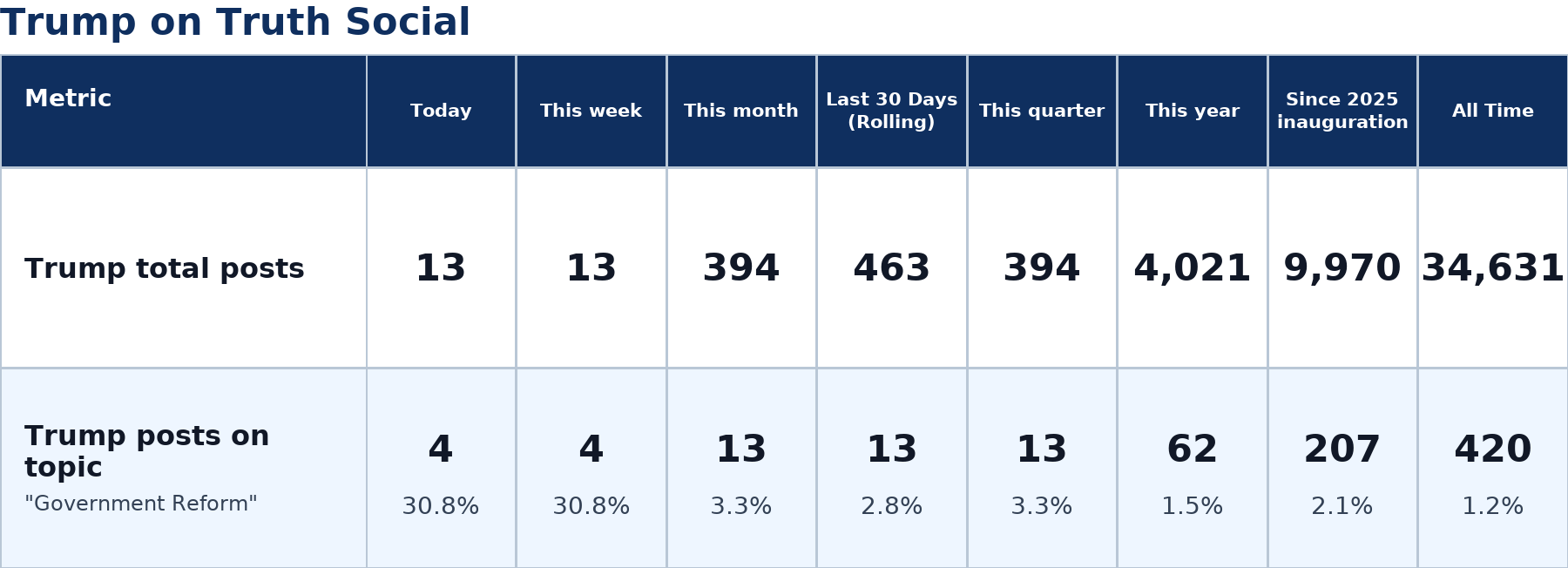
The move fits a broader pattern in Trump’s recent messaging, with 13 of his 463 posts over the last 30 days focused on government reform.

President Donald J. Trump posted an opinion piece on Truth Social at WASHINGTON D.C.
© copyright Zenger.News
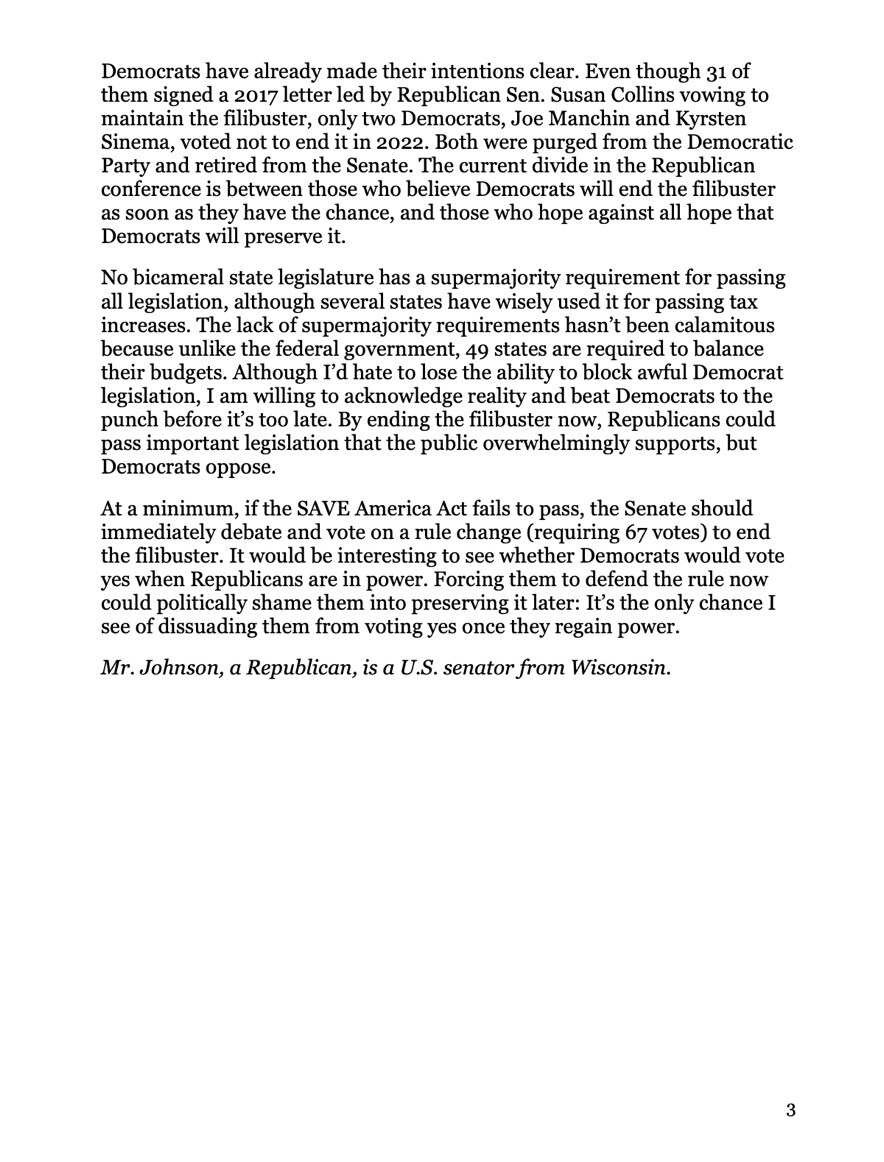
Johnson pointed to prior fights over the rule to argue that Democrats will not preserve it. He noted that 31 Democrats signed a 2017 letter led by Republican Sen. Susan Collins vowing to keep the filibuster, yet only Joe Manchin and Kyrsten Sinema voted against ending it in 2022. Both later left the Senate. Johnson proposed that if the SAVE America Act fails, the chamber should debate a rule change requiring 67 votes to end the filibuster.
Supporters of scrapping the rule say it would let a governing majority deliver on its promises. Opponents say it would strip the minority of leverage and swing policy sharply with each change of power. Johnson conceded he would hate to lose the ability to block Democratic bills, but said he was willing to beat Democrats to the punch.
Johnson wrote that no bicameral state legislature imposes a supermajority requirement for all legislation, and that 49 states must balance their budgets, unlike the federal government. That comparison frames the filibuster as a federal outlier rather than a norm of American governance.
This has happened before at the committee level. The Senate scrapped the 60-vote threshold for most executive and judicial nominations in 2013, then extended it to Supreme Court picks in 2017. Neither party has yet removed it for regular legislation.
The next move rests with Senate Republican leadership, which controls whether a rule-change vote reaches the floor. A date for any such vote has not been announced, and Johnson tied his proposal to the fate of the SAVE America Act.
Senate fights over its own rules are as old as the chamber itself. The filibuster grew out of an 1806 decision to drop a rule allowing a simple majority to cut off debate, a change Vice President Aaron Burr recommended as unnecessary, according to britannica.com. The tactic went largely unchecked until 1917, when the Senate adopted cloture to end debate, later lowering the threshold from two-thirds to three-fifths in 1975. Each reform reshaped how much power a determined minority could wield.
NewsFindr Chart Maker
Photo by Zenger real-time database of all Truth Social posts.
Zenger analysis
Photo by Zenger analysis