
Army Maj. Gen. Feltey Nominated to Lead V Corps at Fort Knox
Thomas M. Feltey, commanding general of the 1st Cavalry Division at Fort Hood, Texas, would pin on a third star to command the Army's forward corps in Europe.

Thomas M. Feltey, an Army major general who commands the 1st Cavalry Division, was nominated for a third star to lead V Corps.
The nomination advances Feltey to the grade of lieutenant general and assigns him as commanding general of V Corps at Fort Knox, Kentucky, the Department of War said in a statement dated July 16, 2026. He now leads the 1st Cavalry Division at Fort Hood, Texas, one of the Army’s premier armored formations. V Corps stands as the Army’s forward-deployed corps headquarters, with a mission focused on operations across Europe, according to war.gov. The command reactivated in 2020 after nearly a decade of dormancy and now rotates elements between Fort Knox and a forward command post in Poland.
The promotion carries weight beyond a single officer’s career. A lieutenant general oversees corps-level formations that can number tens of thousands of soldiers, and the V Corps assignment places Feltey at the center of the Army’s posture toward NATO’s eastern flank. Soldiers under his command, allied partners in Europe, and the units rotating through Poland all stand to gain or lose from the leadership continuity the change represents. The Senate must confirm the nomination before Feltey pins on the third star, and general officer nominations move through the Senate Armed Services Committee.
The announcement forms part of a steady flow of senior officer moves this year, one of 109 officer nominations announced so far in 2026. The Army accounts for 74 of those nominations, the most of any military branch, while Hawaii leads all states with 10. At the same point in 2025, records showed only 26 officer nominations. Has the Army rotated commanders through V Corps at this pace before? It has. Since the corps reactivated in 2020, it has cycled through several commanding generals, each holding the three-star rank while directing training and deployments tied to the European theater. The pattern reflects the corps’ role as a rotational headquarters rather than a permanently garrisoned formation.
For the average reader, the change touches the broader question of how the United States stations and leads its forces near Russia and its neighbors. Corps commanders shape how quickly and how heavily American units can respond to a crisis in Europe, and leadership at that level sets the tempo of exercises that involve allied armies and equipment. The Senate Armed Services Committee will take up the nomination next, and the panel typically bundles such promotions for confirmation. No date for that action has been announced.
Corps commands have anchored American power in Europe as far back as the two world wars. V Corps landed at Omaha Beach on June 6, 1944, during the Normandy invasion, and its soldiers pushed inland through France and into Germany over the following months. The corps later spent the Cold War headquartered in Frankfurt, guarding the Fulda Gap against a feared Soviet thrust. It drew down and stood back up decades later to face a new confrontation on the same continent.
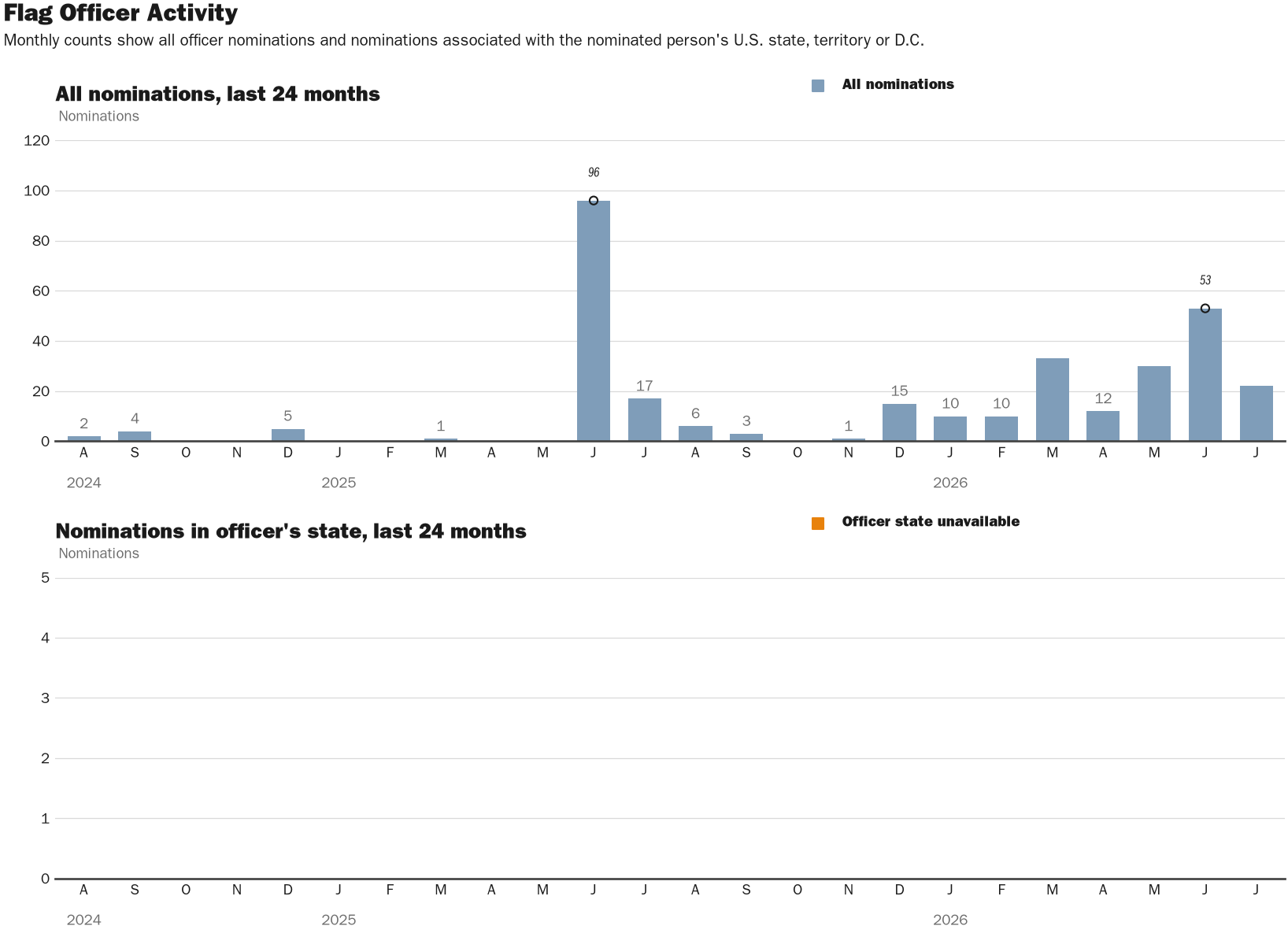

Source: NewsFindr Chart Maker
Note: Chart generated by NewsFindr on July 16, 2026 at 4:31 PM ET

Source: OpenTopoMap / Natural Earth – Texas
Note: Map generated by NewsFindr for Texas on July 16, 2026 at 4:34 PM ET