Appeals Court Rejects Bid to Block Trump’s Mail Voting Restrictions
Trump wins a D.C. Circuit ruling that lets his mail-in voting overhaul stand for now, as Democrats led by Chuck Schumer press their challenge toward the Supreme Court.

WASHINGTON D.C. — Donald J. Trump won a federal appeals court ruling that keeps his mail-in voting overhaul alive, as judges declined to block the order before November’s election.
A U.S. Court of Appeals for the District of Columbia Circuit panel upheld a May decision that denied Democrats a preliminary injunction, ruling that the challenge is not yet ripe for review, according to theepochtimes. The panel of Circuit Judges Patricia Millett, Robert Wilkins and Gregory Katsas issued a per curiam opinion.
“While Plaintiffs have identified a number of serious questions concerning the lawfulness of proposed actions if implemented on the threshold of the upcoming federal election, this case likely is unripe for review in its present posture,” the panel said in its opinion, according to theepochtimes.
The decision hands the president a procedural victory in a fight that could reshape how millions of Americans register and cast ballots, and it signals that courts may still intervene once agencies act.
Here is the full post on truthsocial: “Federal Appeals Court Rejects Bid to Block Trump’s Mail Voting Restrictions: https://www.theepochtimes.com/us/federal-appeals-court-rejects-bid-to-block-trumps-mail-voting-restrictions-6.1 million” on July 31, 2026 at 9:46 PM ET.
This is Trump’s 6th message released today. On average, Trump produces 18 posts per day since his inauguration on January 20, 2025.
The move fits a broader pattern in Trump’s recent messaging, with 73 of his 445 posts over the last 30 days focused on elections.
Trump shared the article by mentioning the source (see theepochtimes). The order directed federal officials to compile lists of American citizens and to compel states to let only listed people register and vote, according to theepochtimes. The challenge came from Democrats including Senate Minority Leader Chuck Schumer of New York, the ranking Democrat in the chamber.
The ruling carries clear winners and losers. The administration keeps its executive order in play through the campaign season, while voting-rights groups warn that citizenship-list requirements could bar eligible voters. Election officials in states that sued now face uncertainty over which rules govern the November contest.
The legal path has split the courts. A different federal judge in June blocked the order in about two dozen states and the District of Columbia, which had sued in Massachusetts, ruling that the order exceeded presidential power, according to ntd.com. A U.S. Court of Appeals for the First Circuit panel upheld that block in a 2-1 decision, warning the order “would sow confusion and threaten disenfranchisement of many eligible voters,” according to ntd.com.
Mail-in voting has grown into a central feature of American elections, used by tens of millions of voters, which magnifies the stakes of any nationwide rule change. For the average reader, the outcome could determine whether their registration is checked against a federal citizenship list before a ballot counts. The dispute reaches households in every state that expanded absentee voting during the past decade.
This has happened before. Federal courts repeatedly weighed emergency challenges to voting rules during the 2020 cycle, when judges split over mail-ballot deadlines and signature-matching procedures. Rulings then also turned on questions of timing and standing rather than the underlying merits.
The next decision rests with the U.S. Supreme Court, which the administration asked to intervene on July 26. Solicitor General D. John Sauer told the justices the injunction “irreparably harms the government” because there is not enough time to obtain ordinary appellate relief before the November election, according to theepochtimes. A date for the high court’s action has not been announced.
Clashes over ballot access have shaped American politics for generations, as happened before. The Voting Rights Act of 1965 followed the Selma-to-Montgomery marches and outlawed literacy tests that had blocked Black voters across Southern states. In Shelby County v. Holder in 2013, the Supreme Court struck down a key enforcement formula in a 5-4 ruling, freeing several states to change election rules without federal preclearance. That decision reshaped voting law for a decade, leaving fights like the current one to unfold court by court.
Assigned topic: Elections.
This is Trump’s 6th Truth Social post today, out of 6 total today.
On average, Trump produces 18 posts per day since his inauguration on January 20, 2025.
Trump’s last post was 4 hours ago.
This post is not part of a thread.
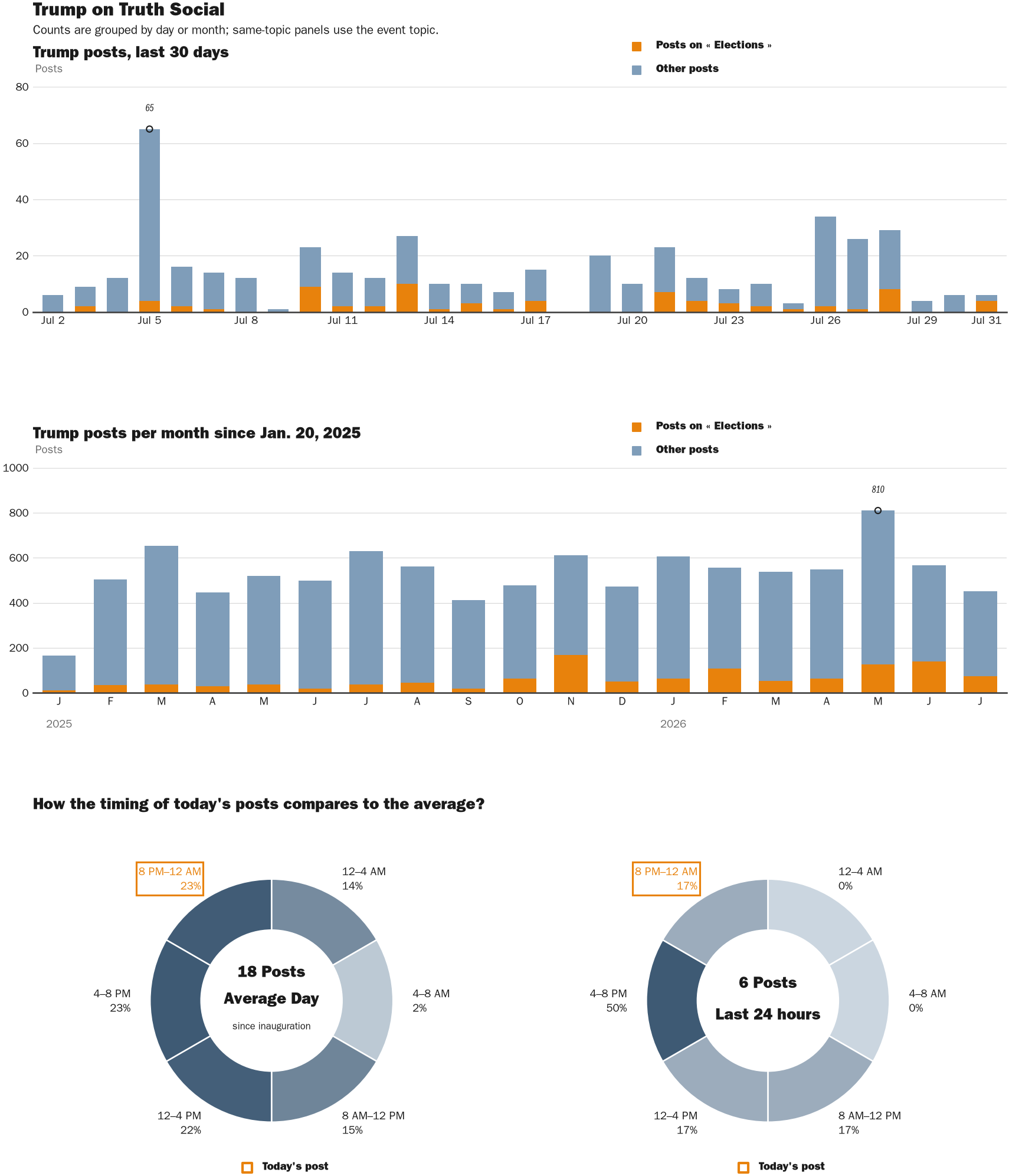

NewsFindr Chart Maker
Photo by Zenger real-time database of all Truth Social posts.
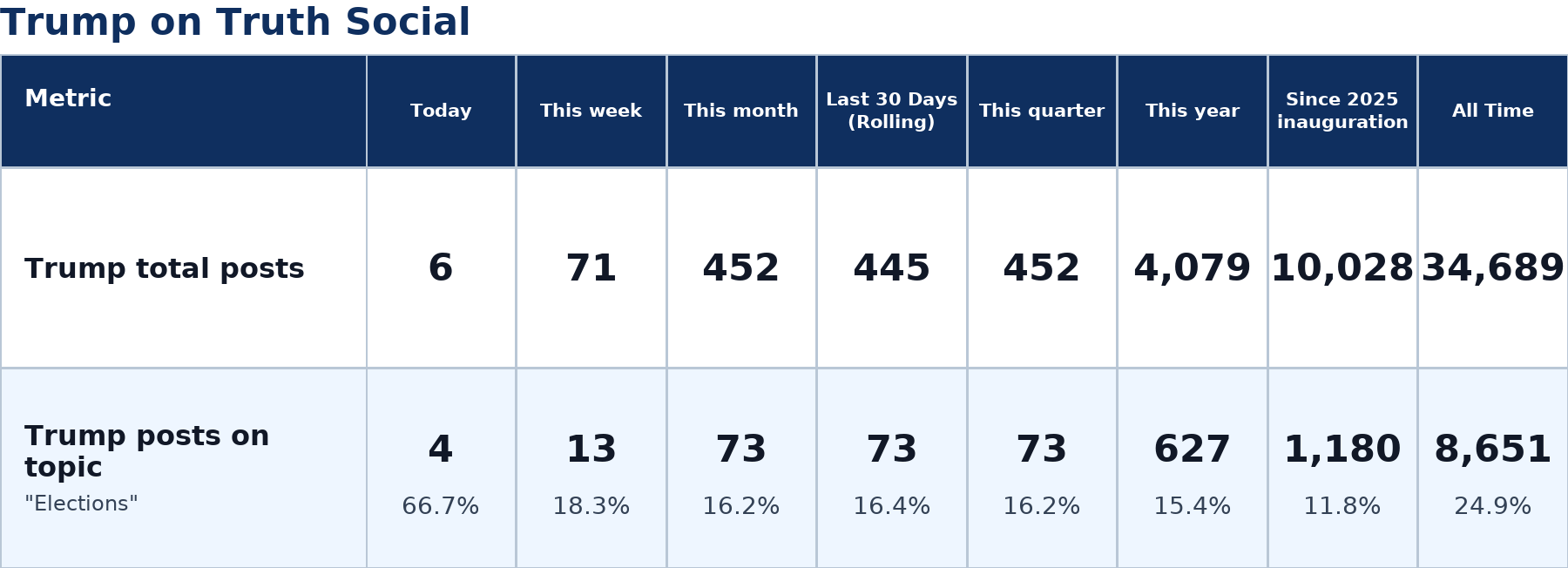
Zenger analysis
Photo by Zenger analysis