
Trump warns Republicans against Democratic push on Supreme Court and filibuster
Trump the president cited a Politico report on House Democratic caucus leaders targeting the Supreme Court and the Senate filibuster, warning such action would leave the Republican Party “DEAD.”.

WASHINGTON D.C. — Donald Trump warned that his party would be finished if it enabled a Democratic drive against the Supreme Court and the Senate filibuster.
Here is the full post on truthsocial: “They do this, and the Republican Party is DEAD! Key House caucus leaders target Supreme Court, Senate filibuster: https://www.politico.com/live-updates/2026/06/24/congress/dem-caucuses-target-scotus-00973895”
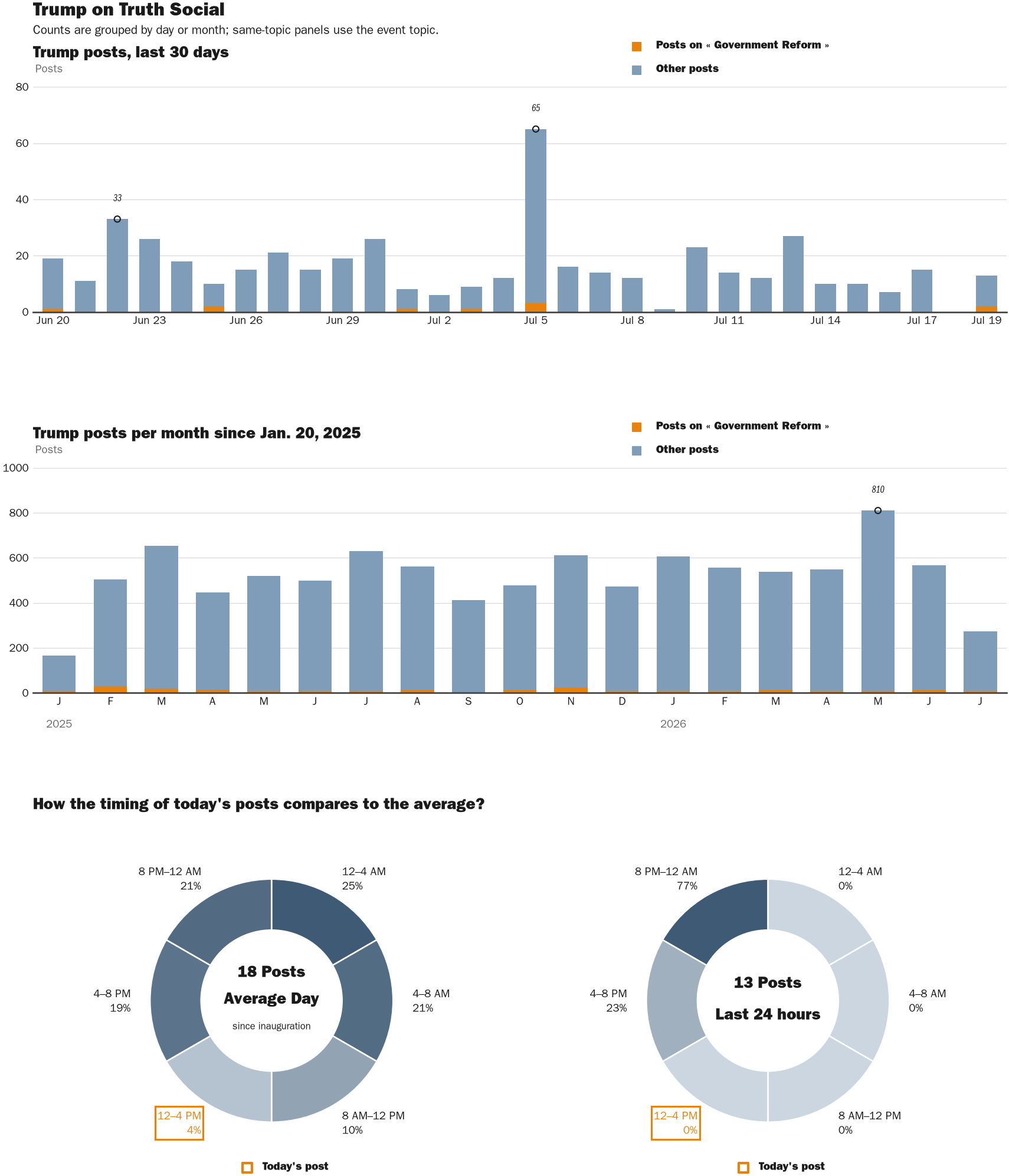
Trump made the remark on Truth Social, the platform he controls through Trump Media & Technology Group, in a post on July 19, 2026 at 2:21 PM ET. He linked to a Politico report describing how House Democratic caucus leaders have set their sights on the high court and the chamber’s 60-vote threshold according to politico. The president framed the reported effort as an existential threat rather than a routine legislative fight.
The stakes reach the core structure of American government. The filibuster requires 60 votes to advance most legislation in the 100-seat Senate, giving the minority party leverage to block bills. Ending it would let a simple majority pass sweeping measures, a change that would benefit whichever party holds the Senate and disadvantage the party out of power. Proposals aimed at the Supreme Court range from term limits to expanding the number of justices beyond the current nine.
The Supreme Court has held nine seats since 1869, when Congress fixed the number by statute. President Franklin D. Roosevelt tried to enlarge the court in 1937 with a plan to add up to six justices, and the Senate rejected the measure by a vote of 70 to 20. The filibuster itself has been narrowed twice in the past decade, once in 2013 for most nominations and again in 2017 for Supreme Court confirmations.
For the average reader, the outcome would shape which laws pass and which stall for years. A Senate without the filibuster could move quickly on taxes, health care, voting rules and immigration, meaning policies could swing sharply each time control of Congress changes hands.
Has this happened before? It has. Both parties have chipped away at Senate rules when frustrated by the minority, and calls to reshape the Supreme Court have surfaced repeatedly across more than a century of American politics. Each prior attempt to expand the court, however, failed to become law.
The next move rests with Senate leaders and the House Democratic caucus figures named in the report. No date for a formal vote or decision has been announced.
Battles over the Supreme Court’s size are not new to Washington. Roosevelt, fresh off a landslide reelection in 1936, unveiled his court-packing bill in February 1937 to overcome justices who had struck down New Deal programs. The plan collapsed within months as members of his own party revolted, and the Judiciary Committee branded it a needless danger to constitutional government. Roosevelt won few friends and lost political capital, and no president since has succeeded in changing the number of justices.

NewsFindr Chart Maker
Zenger analysis