House Panel Refers Jack Smith for Prosecution, Accusing Him of Lying to Congress
Trump amplifies a criminal referral of the former special counsel, as the House Judiciary Committee accuses Smith of misleading lawmakers about access to their private text messages.

WASHINGTON D.C. — Donald J. Trump seized on a House criminal referral of former Special Counsel Jack Smith, celebrating the move on Truth Social as long-awaited retribution against the prosecutor who once pursued two federal cases against him.
The House Judiciary Committee accuses Smith of lying to Congress about his team’s access to the private text messages of more than 40 lawmakers, and it urges the Justice Department to prosecute him. Trump broadcast the news to his followers with a single question and a link to a report, by mentioning the source (see justthenews).
“Justice at last??? House panel accuses Jack Smith of lying to Congress, urges DOJ to prosecute,” Trump wrote in his post.
Here is the full post on Truth Social: “Justice at last??? House panel accuses Jack Smith of lying to Congress, urges DOJ to prosecute: https://justthenews.com/government/congress/jim-jordan-sends-jack-smith-criminal-referral-justice-department” on July 23, 2026 at 5:31 AM ET.
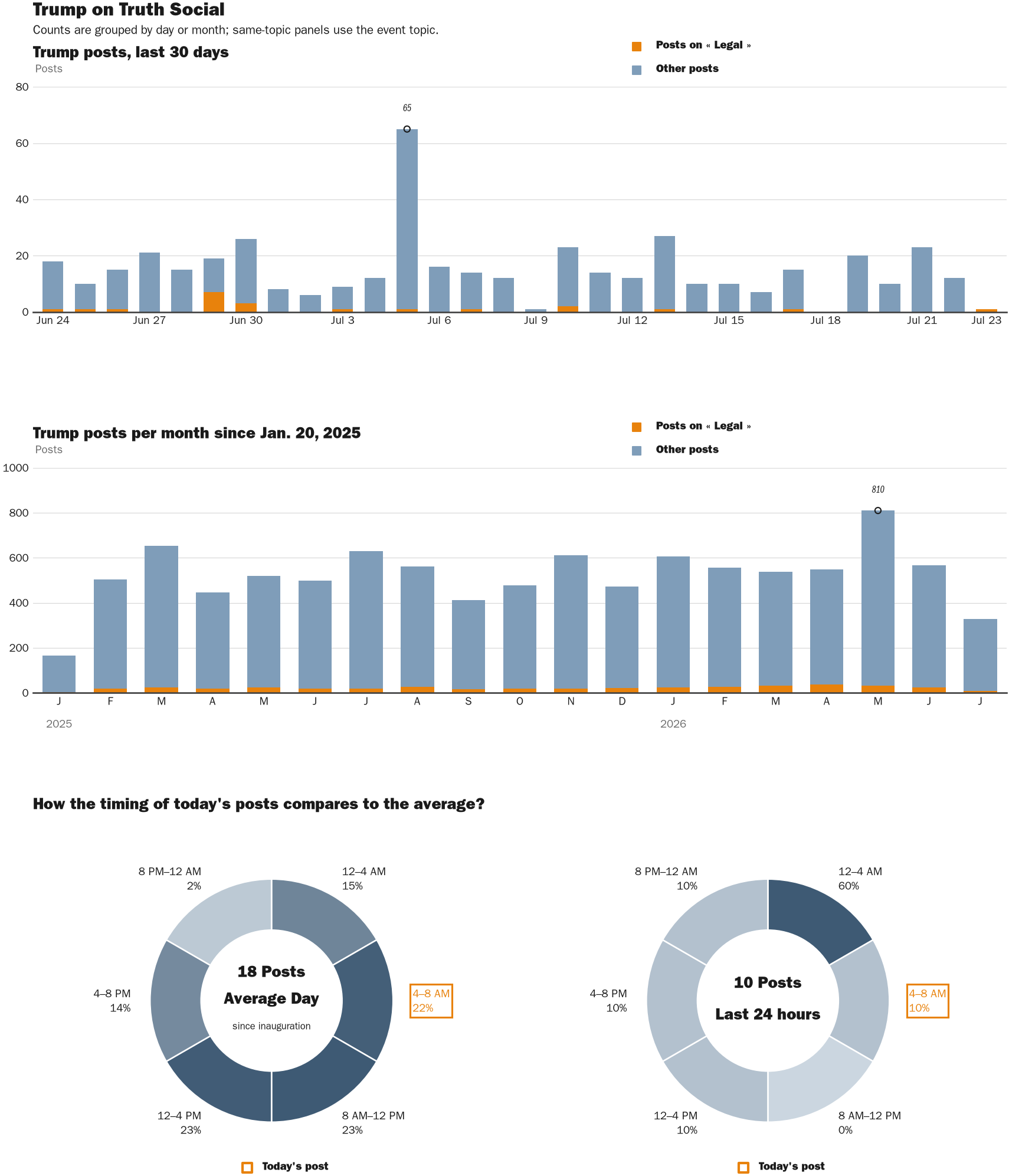
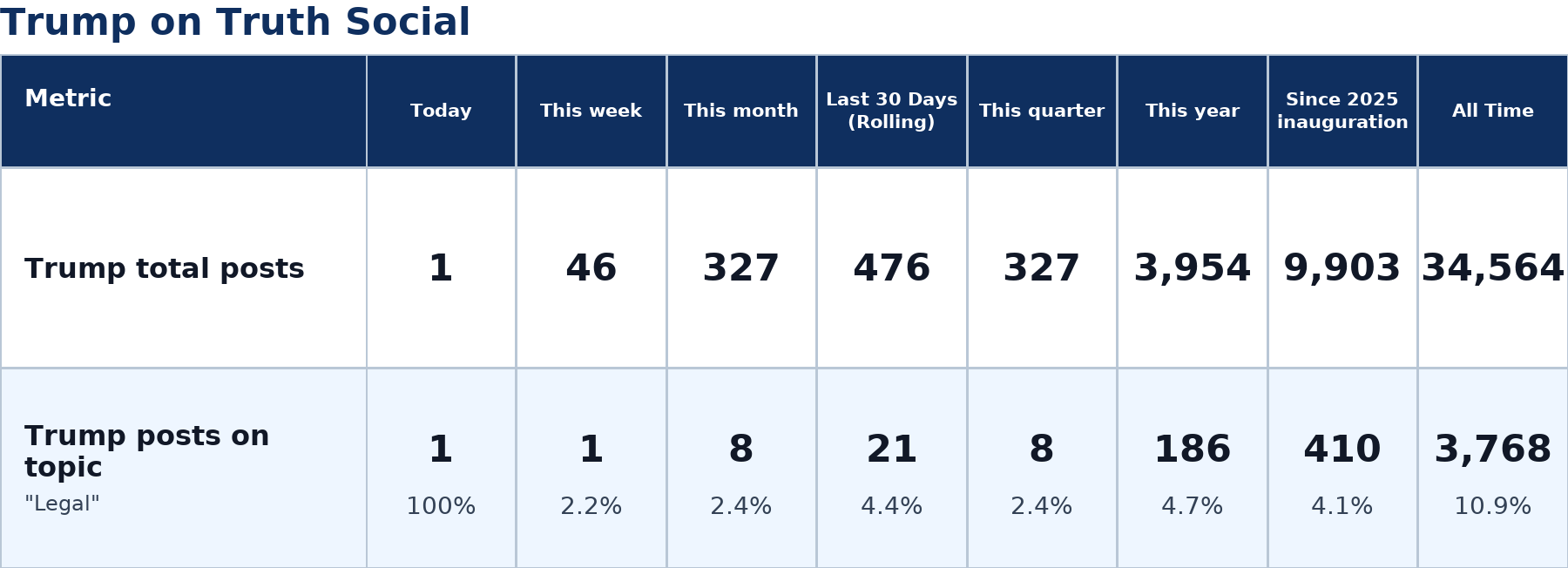
This is the first message released by Trump today. On average, Trump produces roughly 15 posts per day since his inauguration on January 20, 2025.
The move fits a broader pattern in Trump’s recent messaging, with 21 of his 476 posts over the last 30 days focused on legal matters.
House Judiciary Committee Chairman Jim Jordan referred Smith for criminal prosecution late Wednesday, alleging he lied about his team’s access to the contents of private text messages of over 40 lawmakers, according to justthenews. The referral accuses Smith of misleading Congress last year when he testified that the toll records his team requested for members did not include the content of those messages. It also faults Smith for his answer when asked whether he ever subpoenaed the text messages of lawmakers.
“This information calls into question the completeness and accuracy of statements that Mr. Smith made under oath to the Committee regarding his team’s access to the content of Members’ text messages,” Jordan wrote in the referral, which he transmitted to Acting Attorney General Todd Blanche, according to justthenews.
The stakes reach beyond one prosecutor. A conviction for lying to Congress would end Smith’s career and hand Trump allies a symbolic victory, while a Justice Department decision to decline the referral would leave the accusation as a political statement without legal force. Members of Congress whose records were swept up sit on both sides of the fight.
House Judiciary Committee Ranking Member Jamie Raskin, an attorney and former law professor, rejected the referral and defended Smith. He said Smith compelled the National Archives to produce White House records that included the text messages but did not subpoena the phone records, making his testimony accurate. “Jack Smith was clear and consistent in his testimony, and he told the truth,” Raskin said, according to justthenews.
For the average American reader, the dispute signals how far the branches of government have moved toward using investigative power against one another. A referral does not compel charges; the decision rests with prosecutors, and the outcome will shape whether officials can face pursuit for the wording of sworn testimony.
This has happened before. Congressional committees have referred officials for prosecution over testimony many times, yet the Justice Department frequently declines to act, and referrals rarely produce convictions. The pattern makes the practical impact uncertain even as the political charge stays high.
The next decision falls to Acting Attorney General Todd Blanche and the Justice Department, which received the referral. No date for a charging decision has been announced.
Criminal referrals of prosecutors are not the first time Washington has turned its investigative machinery inward. In 1998, independent counsel Kenneth Starr faced accusations from lawmakers that his own conduct crossed legal lines during the inquiry that led to President Bill Clinton’s impeachment. Starr endured years of scrutiny and left public prosecution behind, later becoming a university president. The episode showed that the prosecutor who wields the greatest power often becomes the next target once the political winds shift.

NewsFindr Chart Maker
Photo by Zenger real-time database of all Truth Social posts.
Zenger analysis
Photo by Zenger analysis