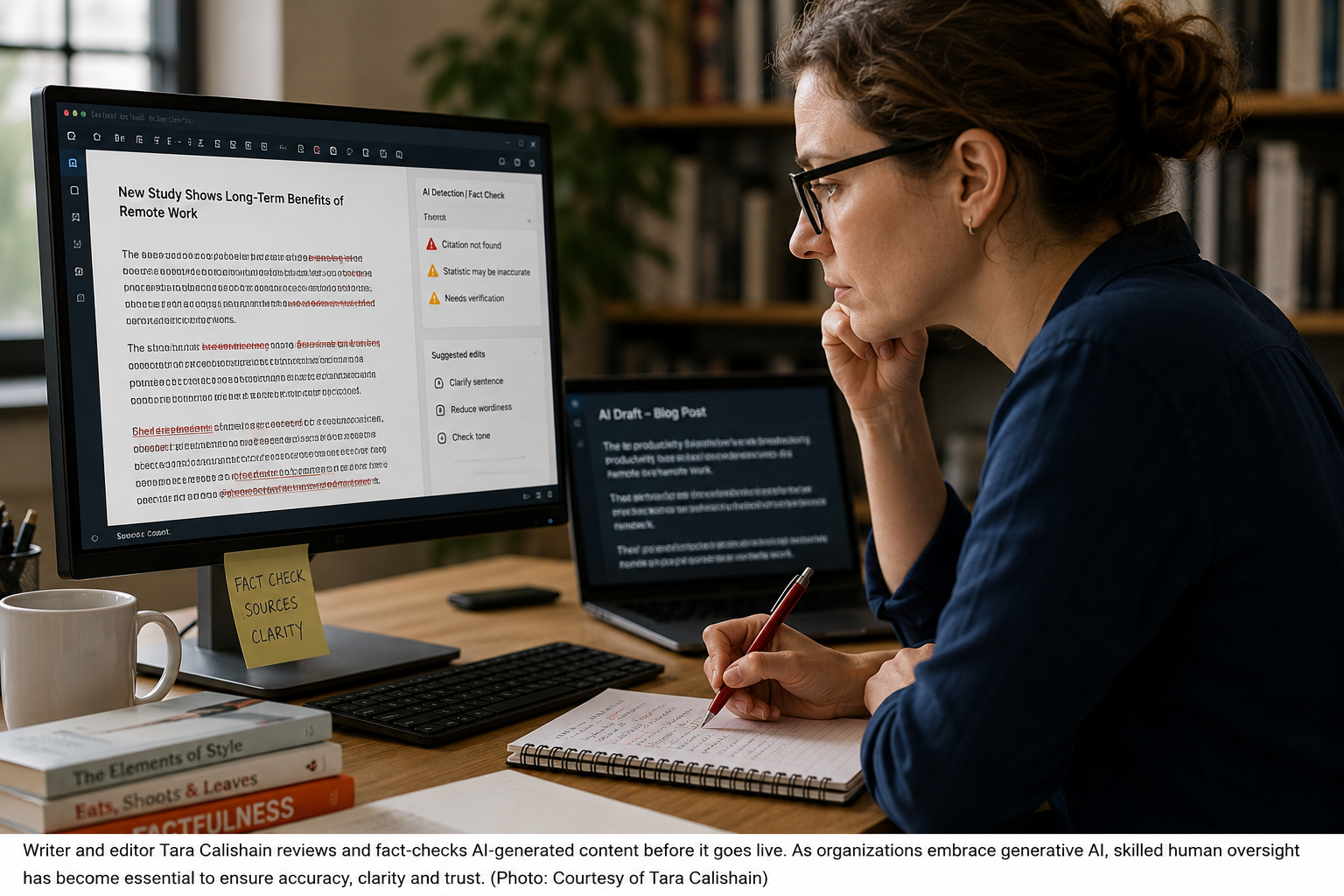
The AI boom is creating a new market for human proofreaders
Companies are hiring proofreaders and fact-checkers to ensure AI-written content meets professional standards.

NEW YORK — A marketing manager at a mid-sized software company thought artificial intelligence had cut her workload in half. Within minutes, an AI assistant could draft blog posts, product descriptions, and customer emails that once took hours to write.
”Because the volume of AI generated content is growing so quickly,”said Tara kela
Before any of it could be published, another employee had to spend nearly as much time correcting errors, rewriting awkward passages, and ensuring the content met legal and brand standards. That scene is becoming increasingly common across industries as organizations embrace generative AI—not to replace editors entirely, but to create a growing need for people whose job is to verify, refine, and approve what the technology produces.
For more than two decades, Tara Salishan, an American writer, editor, and internet research expert based in the United States, has built her career around one principle: helping people find and trust accurate information online. As organizations increasingly rely on generative AI to produce articles, marketing copy, customer support responses, and internal documents, Salishan’s expertise has become even more valuable. While AI can generate polished text in seconds, she knows that speed does not guarantee accuracy. Reviewing AI-generated content often means checking facts, verifying sources, correcting misleading context, and refining language before it is published.
The shift is backed by growing evidence that AI is transforming jobs rather than simply replacing them. According to the World Economic Forum’s Future of Jobs report, based on a survey of more than 1,000 employers representing over 14 million workers across 55 economies, 86% of employers expect AI and information-processing technologies to reshape their businesses by 2030. The report projects that while 92 million jobs could be displaced over the next five years, 170 million new roles will be created, resulting in a net gain of 78 million jobs, with many of those opportunities requiring uniquely human skills.

Slim Lacto in Lakeview on July 3, 2026 at 9:13 PM. Photo: Slim/Luna. © Lunastudiolens2026
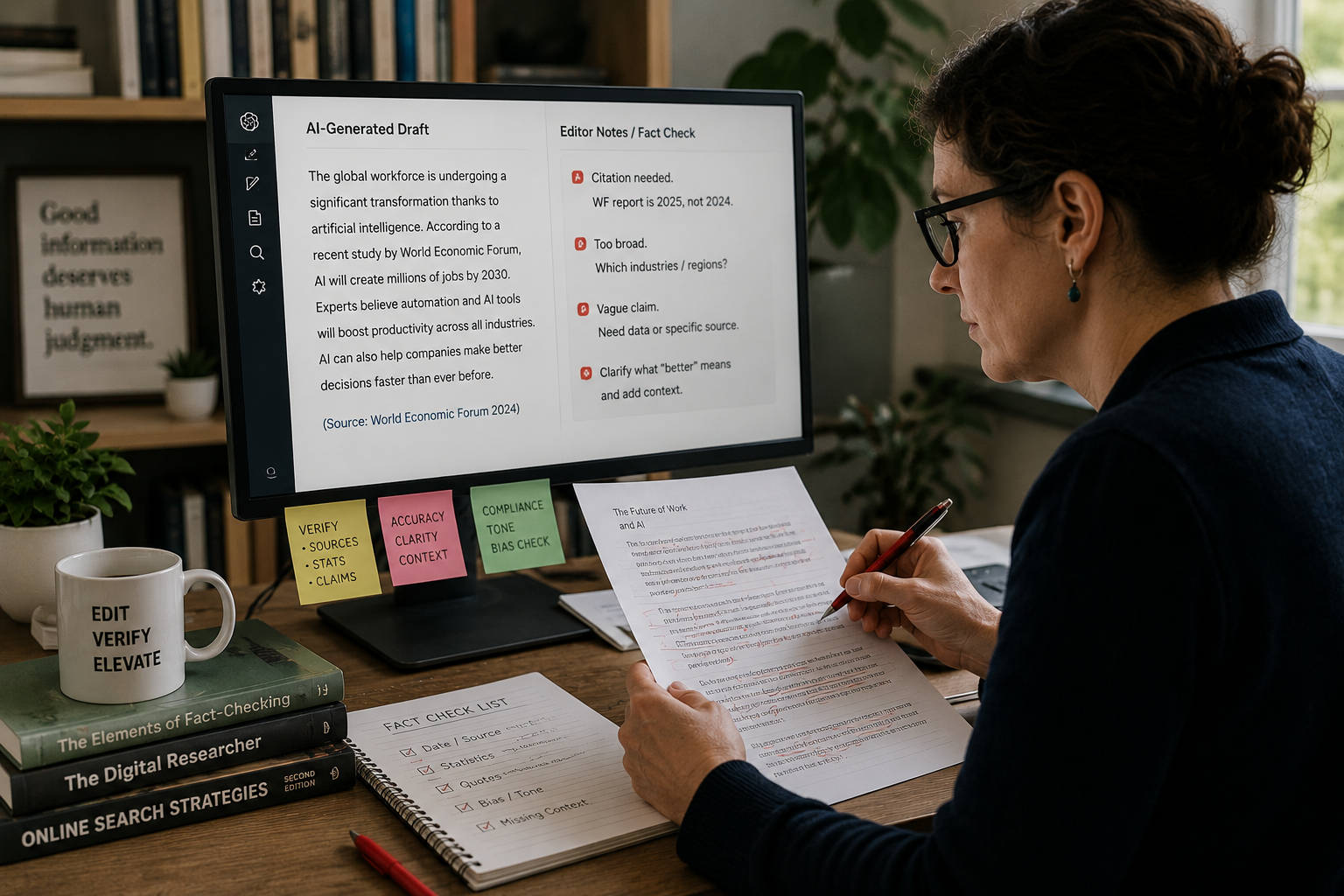
The tension lies in the gap between AI’s speed and its reliability. Businesses benefit from generative AI because it can produce articles, reports, marketing copy and customer communications in seconds, reducing costs and increasing productivity. But editors, researchers, and communications professionals are pushing back against the idea that AI can be trusted on its own. They argue that the technology can fabricate sources, misstate facts, introduce bias, and miss important context—mistakes that can damage a company’s reputation or expose it to legal risks.
As generative AI becomes embedded in more workplaces, the demand for human oversight is likely to grow alongside it rather than disappear. Companies may continue automating the first draft, but the final responsibility for accuracy, context, and credibility will remain with people who can exercise judgment that machines cannot. The next phase of the AI revolution may not be defined by how much content artificial intelligence can create, but by how much trust skilled human editors can restore before that content reaches the public.