
World Wide Technology Wins $14.9 Million Marine Corps IT Contract
The St. Louis firm will supply modular, deployable command-post hardware and licenses to Fleet Marine Forces under a firm-fixed-price award, with work due by Dec. 3, 2026.

ST. LOUIS, MISSOURI — World Wide Technology LLC won a $14.9 million contract to equip Fleet Marine Forces with deployable command-post technology.
The firm-fixed-price award covers Operational Command Post – Heavy hardware and licenses, and carries no option years, according to war.gov.World Wide Technology LLC, a St. Louis, Missouri, technology reseller and integrator, will deliver modular information technology infrastructure built to run at the tactical edge, as announced on war.gov.
The system supplies a scalable architecture that hosts and rapidly deploys secure, enterprise-grade services in disconnected, intermittent, and limited environments. Marine units operating far from fixed networks depend on such gear to sustain communications and data services when links to headquarters fail. The award funds hardware and software licenses under a single fixed price, which shifts cost risk onto the contractor rather than the government.
Marines gain the most direct benefit, receiving portable command centers designed to move with expeditionary forces. The contractor secures guaranteed revenue and a reference deployment inside the Marine Corps. Competing integrators that bid on the same requirement lose a foothold with Fleet Marine Forces, since the government received two offers before making the selection, according to war.gov.
Marine Corps Systems Command, based in Quantico, Virginia, ran the procurement competitively through the NASA Solutions for Enterprise-Wide Procurement vehicle, according to war.gov. Fiscal 2026 Marine Corps procurement funds of $14.9 million were obligated at the time of award, and those funds will not expire at the end of the current fiscal year, according to war.gov. The full maximum dollar value of the contract equals the obligated amount, leaving no room for later increases.
For the average reader, the award reflects how much routine military spending flows to commercial technology firms rather than traditional weapons makers. Command-post modernization determines whether troops in the field can share intelligence and coordinate movements, a capability that underpins the broader readiness taxpayers fund each year.
This has happened before. Federal buyers regularly turn to enterprise resellers for tactical IT packages, and the NASA SEWP vehicle exists specifically to route such orders across agencies, according to war.gov. Repeat awards of this kind form a steady share of Defense Department contracting, with small and mid-size hardware buys announced daily.
Marine Corps Systems Command holds the next decision on any follow-on work tied to the effort. The contract lists an expected completion date of Dec. 3, 2026, and no date for additional orders has been announced, according to war.gov.
Military reliance on private technology suppliers stretches back generations, as happened before with earlier communications overhauls. During World War II, the Signal Corps leaned on commercial manufacturers to mass-produce field radios, and the SCR-300 backpack set fielded in 1943 gave infantry the first widely used voice radio at the front. That partnership between uniformed planners and civilian factories reshaped battlefield coordination, and the officers who championed it saw their command-and-control doctrine become the template for every deployable network that followed.
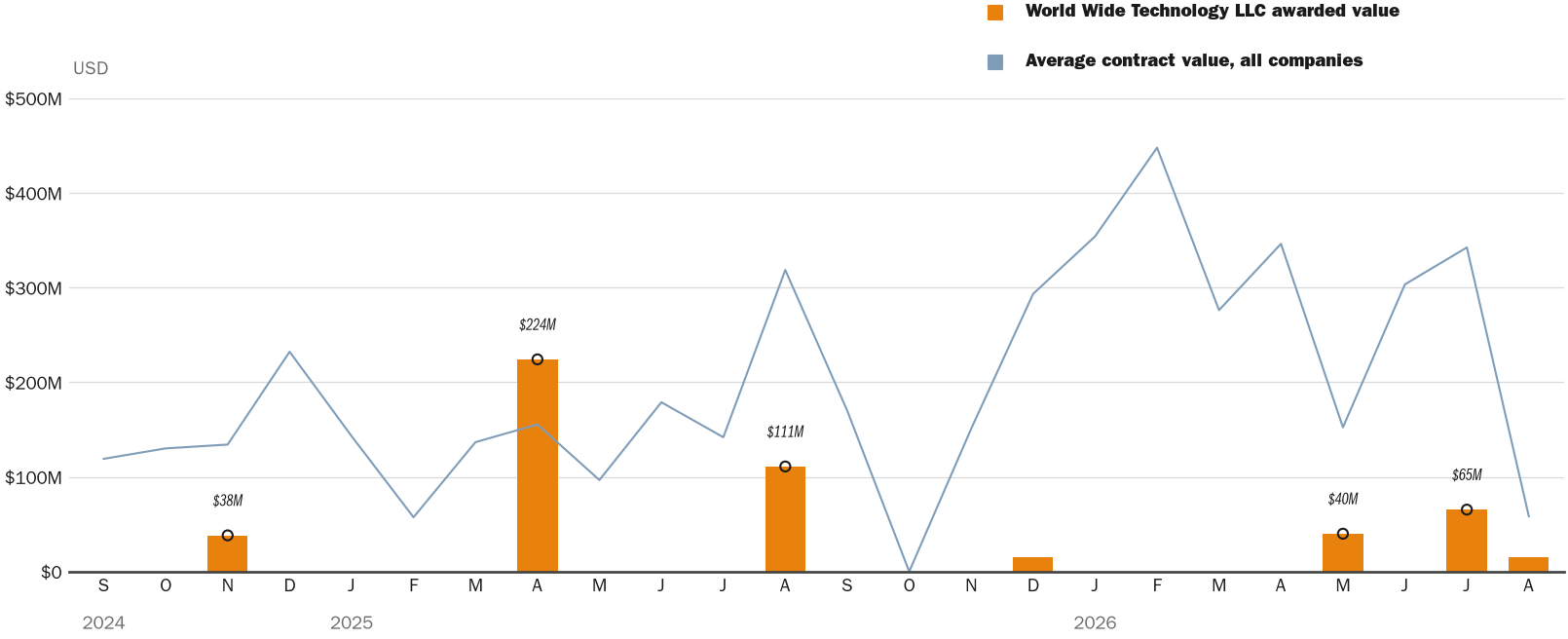

NewsFindr Chart Maker
Photo by NewsFindr Chart Maker

OpenTopoMap / Natural Earth – St. Louis, Missouri