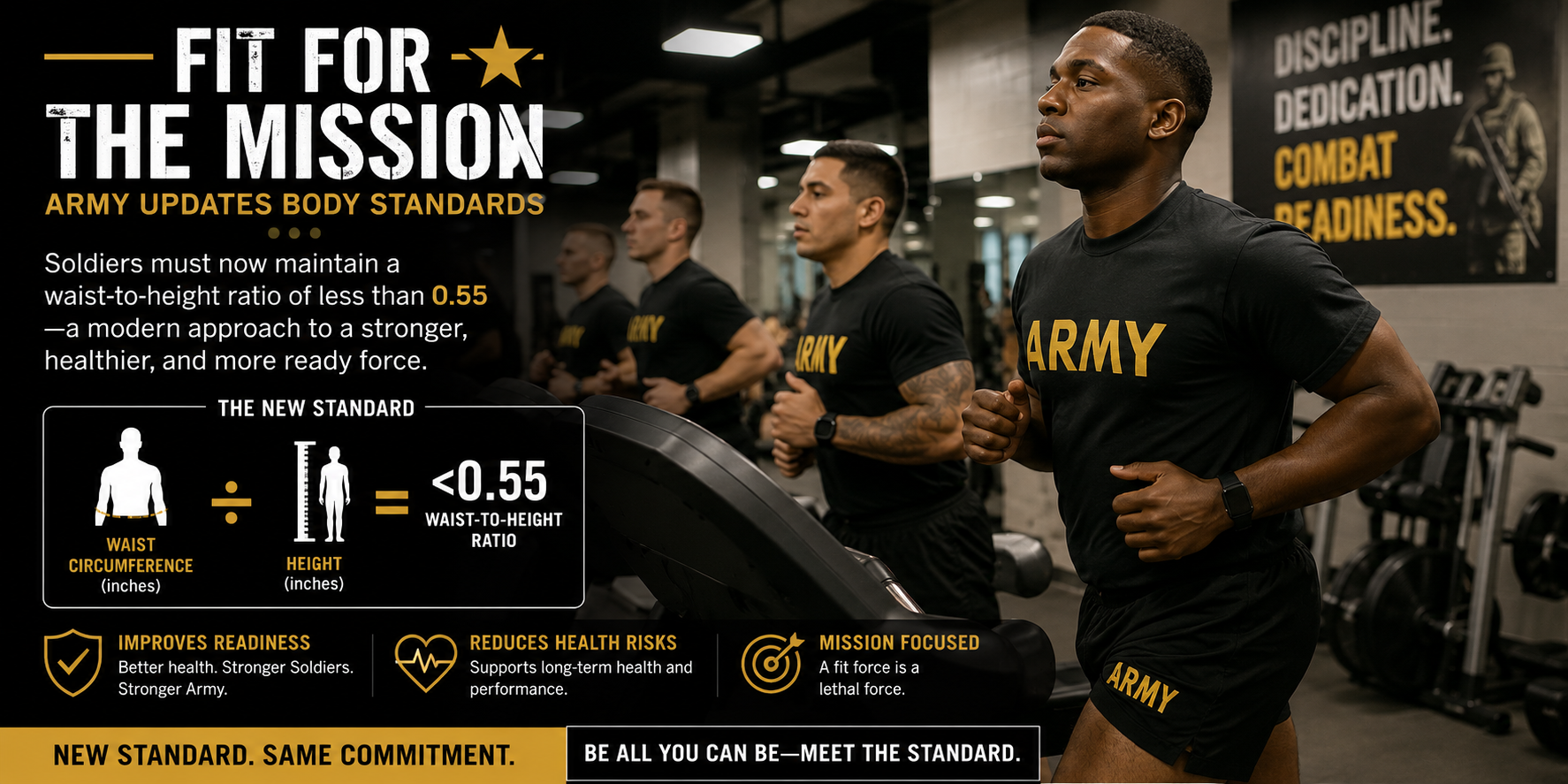
U.S Army Requires Soldiers to Meet New Waist- to-Height Body Standard Rules
Soldiers Must Stay Below 0.55 or Face Mandatory Remedial Training Measured Twice Per Year at the Belly Button.

WASHINGTON — The Defense Secretary, Pete Hegseth enforced a strict new Army waist-to-height fitness body standard in July 2026.
For Pete Hegseth, the policy shift isn’t about cold statistics or compliance percentages; it is a direct reflection of his core vision for the American military. Having served on the ground in Iraq and Afghanistan, he views combat readiness not as a mere administrative box to be ticked off, but in the more vital context of life and death on the battlefield in which any additional inch or pound may prove decisive. The policy, from his perspective, is the abstract mandate that becomes a calculated campaign. The policy intends at eradicating any form of institutional complacency. Therefore, soldiers are forced to confront a new, reality where their military careers are measured by a tape at their midsection.
This battle between the implementation of the Army’s Waist-to-Height Ratio (WHtR) and the current situation of its soldiers is one of those high-stakes conflicts that occur due to the gap between the Pentagon’s demands and the condition of the troops. In light of Defense Secretary Pete Hegseth’s v ision of the absolutely lethal combat capacity of his army, the military command implements a tough rule of under-0.55 metric to eradicate any form of institutional laziness and bureaucratic tricks from the system. The problem is that this particular reform affects not only the regular troops but also dedicated servicemen, outstanding athletes, and muscular combat soldiers who feel that their lean muscle mass was undervalued by the old body-fat tests.
“For decades, the Army’s legacy tape test penalized our most heavily muscled combat troops, misclassifying tons of muscle mass as body fat. The waist-to-height ratio is scientifically fair. Where you carry weight matters more for cardiovascular health than total weight but by making it an absolute threshold under 0.55 with no athletic exemptions, the Pentagon has turned a health screening tool into a rigid career gatekeeper. The rigidity is creating massive anxiety on the ground. High-performing infantrymen who max out their fitness tests could face career freezes or separation over a fraction of an inch. The Secretary pushed for absolute combat lethality, overriding the physical reality of our best athletes. This is the central conflict. Science tells us that the ratio predicts long-term health risk and healthcare costs for taxpayers. On the battlefield, raw physical power doesn’t always fit into a uniform mathematical box. The operational cost of losing experienced, high-performing leaders over minor measurement errors could quickly outweigh the projected medical savings. With a 90-day deadline looming for all active soldiers to log in the initial measurements, the pressure is squarely on the ranks,” said Dr. Karl Fred, a leading researcher in military body composition.
The main issue here is the very personal matter of a soldier’s identity, livelihood, and advancement within the military system. The new policy makes it so that a discrepancy of a mere tenth of a point in the ratio results in an immediate “career flag,” which puts on hold any promotions, reassignment, and admission to prestigious military schools for leadership training. Although the process of dismissal takes six months, during which a soldier is evaluated, the final result will still amount to administrative discharge from service. From the human point of view, it means that each soldier now stands face to face with his commander, realizing that inches of waistline have more value for the bureaucracy than the proven experience on the battlefield.
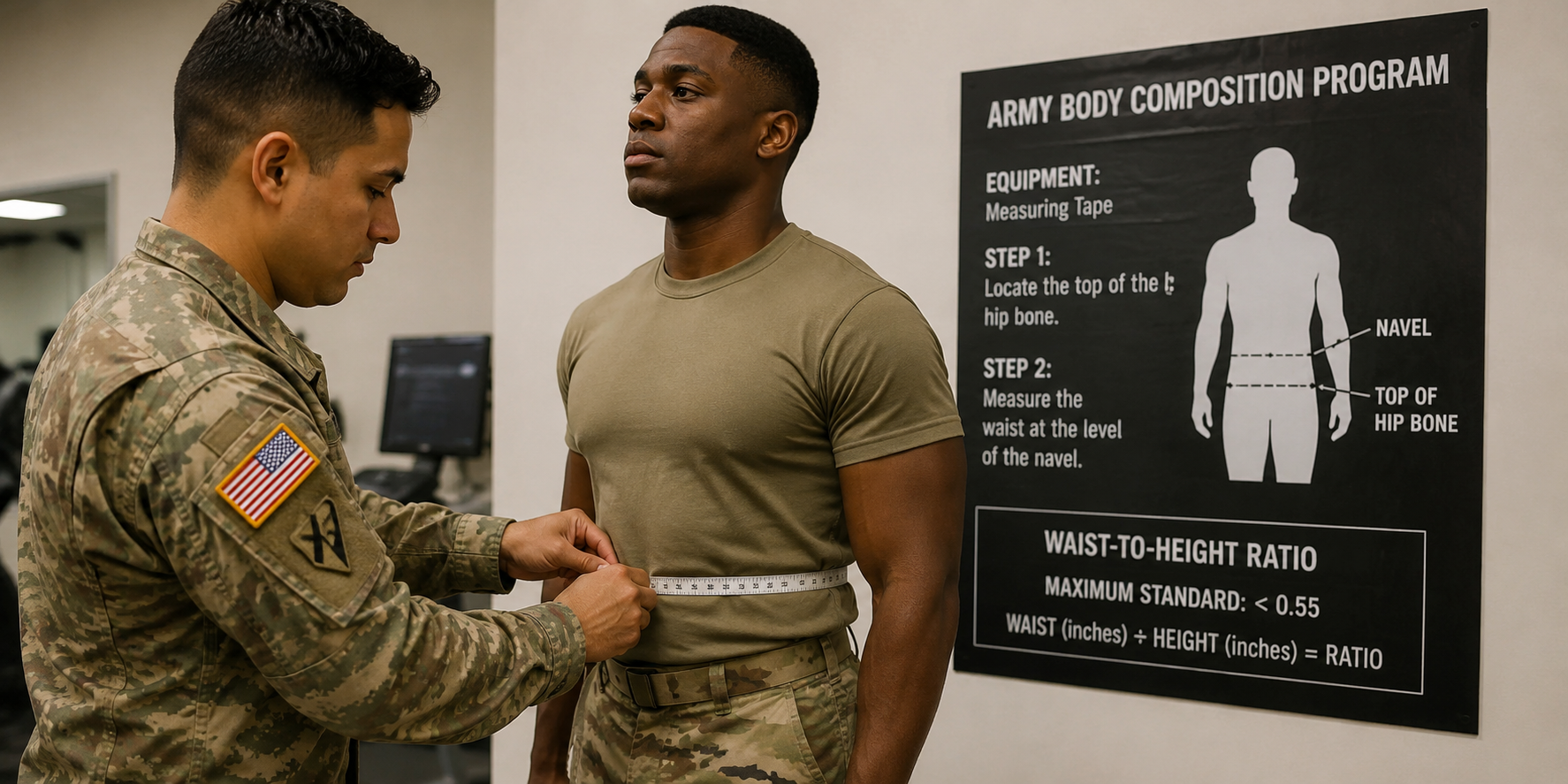

U.S. Army soldier undergoing a body composition evaluation as the military implements new fitness standards aimed at improving health and combat readiness in Washington on July 1, 2026 at 7:48 PM. Photo: AP/Reuters
The transition of this rigid Waist-to-Height Ratio (WHtR) represents the peak of several years’ worth of work within the Department of Defense aimed at updating military fitness criteria. Over the decades, every single branch used traditional height and weight charts, along with the “tape test,” which measured the circumference of the neck and waist. These outdated methods were constantly receiving criticism for not being adapted to modern exercise techniques; they often discriminated against bodybuilders and muscular combat soldiers by confusing their muscle tissue with body fat.
The change to a strict waist-to-height ratio creates important policy considerations, which go beyond the confines of the military bases and affect the general population of taxpayers. Training a soldier into the armed service involves thousands of dollars in taxpayer money; losing skilled soldiers and combat veterans because of failing an insignificant decimal on their bodies translates into a loss for taxpayers who have to foot the bill for hiring new soldiers. In light of the current shortfall in recruitment across all the branches, the loss of capable people means losing valuable resources to ensure public safety. The policy is faced with a difficult choice of saving money on the future medical care of troops, which is extremely expensive to the public.
To guarantee transparency and fairness within the institution, questions about accountability must be asked with respect to the implementation of this mandate. Firstly, there should be clear and data-based evidence to support the claim that there is a proven correlation between the stringent requirement for the 0.550 ratio and the effectiveness or readiness of the soldier in combat or otherwise. Secondly, since an inch of difference can effectively put an end to one’s career in the army, stringent quality assurance and oversight must be ensured to make sure that measuring teams conduct their work objectively without errors or biases.
In light of the 180-day period already being in effect, everyone’s attention turns to the rapidly approaching 90-day deadline by which every active soldier, West Point cadet, and Senior ROTC cadet must have their first Waist-to-Height Ratio recorded in the Army Training Information System. As the unit commanders take full responsibility for managing the tape measures, the question immediately at hand is how the military hierarchy will cope with this strict mandate in the absence of any physical fitness waivers. In addition, a final decision is expected from the top levels of the Pentagon as defense oversight committees assess preliminary statistics collected during the initial assessment period to see if there is a need for any administrative changes prior to imposing separation due to repeated failure.