Trump Claims 98% Endorsement Win Rate in GOP Primaries Since 2018
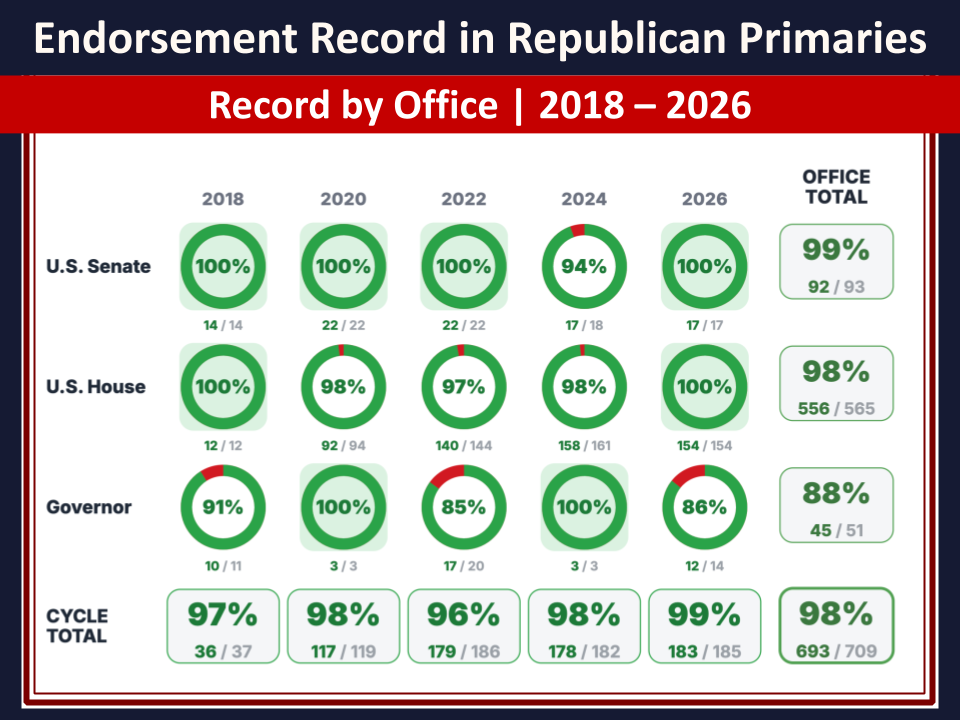
Trump posts a graphic showing his endorsed candidates won 693 of 709 Republican primaries across Senate, House and governor races over five election cycles.

WASHINGTON D.C. — Donald J. Trump claimed his primary endorsements have carried Republican candidates to victory 98% of the time since 2018.
The graphic tallies 693 wins in 709 endorsed Republican primaries across the U.S. Senate, U.S. House and governor’s races over five election cycles, according to the figures Trump shared on truthsocial. Senate candidates won 99% of their races, House candidates 98% and governors 88%, the graphic states.
Here is the full post on truthsocial: “Endorsement Record in Republican Primaries. Record by Office | 2018 – 2026. OFFICE. TOTAL. U.S. Senate. U.S. House. Governor. CYCLE. TOTAL.” on August 4, 2026 at 5:49 PM ET.
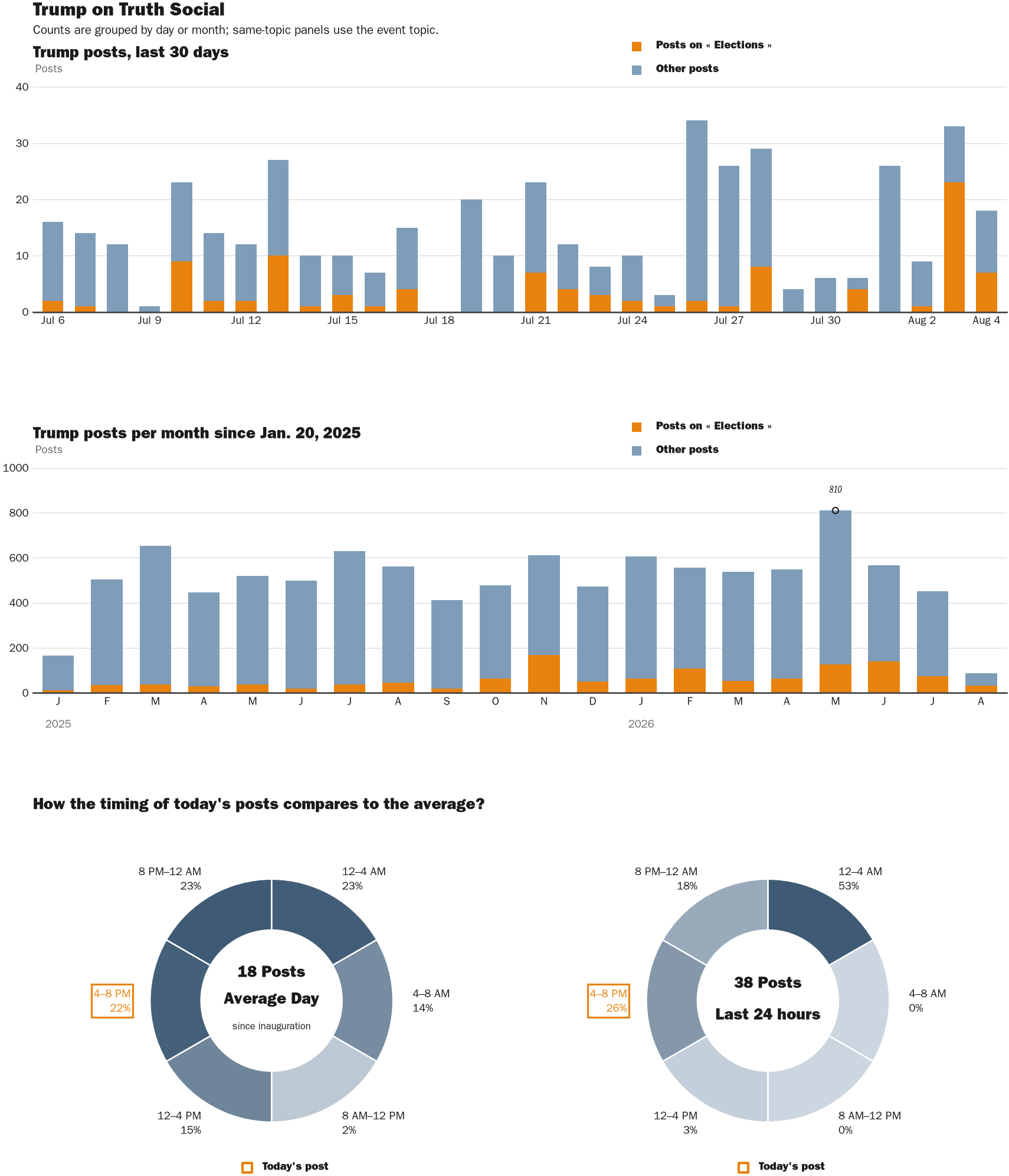
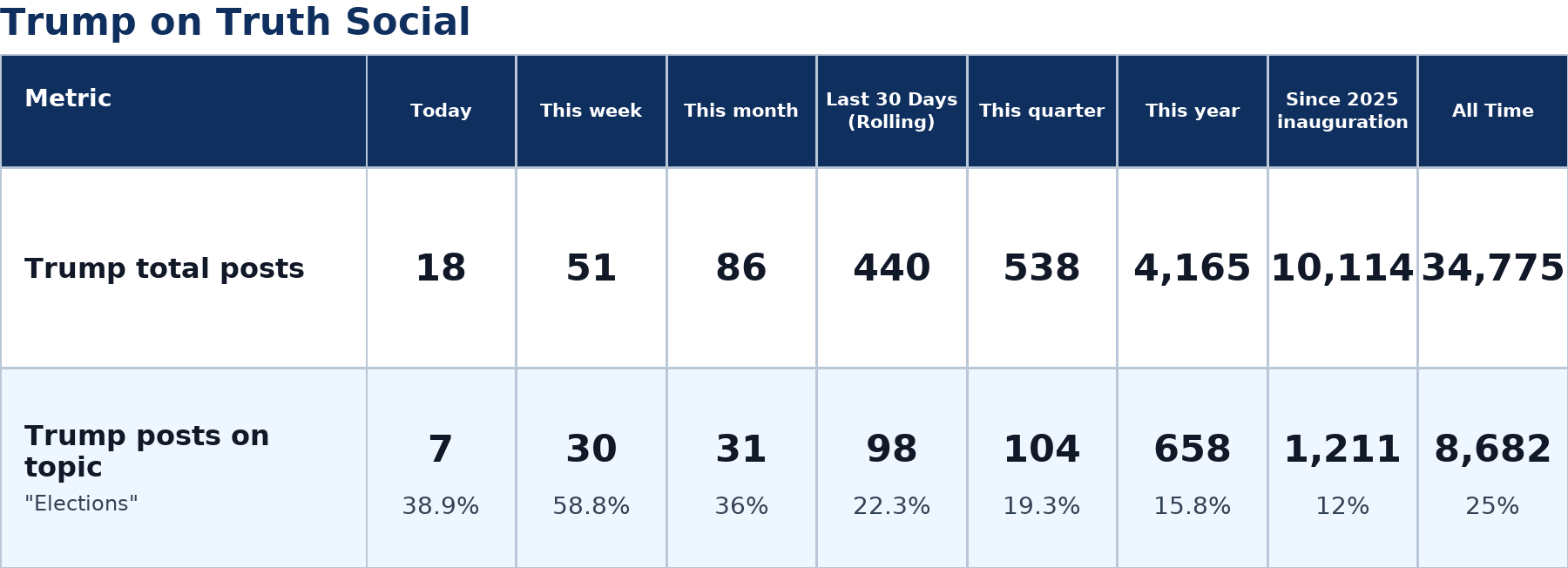
This is Trump’s 18th message released today, and the last post came moments earlier, and it is not part of a thread. On average, Trump produces 18 posts per day since his inauguration on January 20, 2025. The move fits a broader pattern in Trump’s recent messaging, with 98 of his 440 posts over the last 30 days classified as elections posts.
The self-reported chart breaks the record down cycle by cycle. Senate-endorsed candidates went 14 for 14 in 2018, 22 for 22 in both 2020 and 2022, 17 for 18 in 2024, and 17 for 17 in 2026. House endorsements peaked at 154 for 154 in 2026, while governor endorsements lagged at 45 wins in 51 attempts overall, the weakest of the three offices.
The endorsement record functions as political currency inside the Republican Party, where a Trump backing has repeatedly reshaped competitive primaries. The success rate refers to candidates publicly supported by Trump who then won their party contests, according to truthsocial. Endorsements from influential figures have long carried outsized weight in low-turnout primaries, according to lse.ac.uk.
A high win rate strengthens Trump’s leverage over Republican officeholders who seek his backing, while it raises the cost of crossing him for members weighing reelection. Candidates who secure the endorsement gain fundraising momentum and name recognition, according to cambridge.org. Rivals denied it often struggle to consolidate the party base, a dynamic scholars have documented across recent cycles, according to washingtonpost.com.

President Donald J. Trump shared a graphic on Truth Social at WASHINGTON D.C.
© copyright Zenger.News
The raw figures deserve scrutiny because primary endorsements often favor incumbents or clear front-runners already positioned to win. Endorsing likely winners inflates success rates without proving the endorsement changed an outcome, a caveat researchers stress when measuring endorsement power, according to newsweek.com. The 2026 primary data appears alongside completed cycles, and the graphic does not define its methodology for counting a race as endorsed.
For the average voter, the record signals how tightly Trump holds the Republican nominating process heading into the November general election. His favored candidates shape which names appear on primary ballots in Senate, House and governor’s races nationwide. That influence steers which policies and personalities reach the fall ballot in most states.
This is not the first time Trump has publicized his primary scorecard. He touted his endorsement success through the 2018, 2022 and 2024 cycles, drawing challenges over whether the numbers counted only competitive races, according to wikipedia.org. Political scientists have debated the true predictive power of presidential primary endorsements for decades, according to cambridge.org.
Republican voters will next test the record in the 2026 primaries, with contests running through the summer and the general election set for November 3, 2026. No independent audit of the 709-race figure has been announced.
Presidential kingmaking within a party predates modern polling, as happened before. Franklin D. Roosevelt tried to purge conservative Democrats in the 1938 primaries, targeting senators who blocked his agenda, according to britannica.com. Most of his targets survived, and Roosevelt’s failed purge weakened his standing with Congress for the remainder of his second term.
NewsFindr Chart Maker
Photo by Zenger real-time database of all Truth Social posts.
Zenger analysis
Photo by Zenger analysis
OpenTopoMap / Natural Earth – United Kingdom