Trump Sets Zero Tariff on Generic Drugs for Two Years, Then 100%
Trump orders a two-year zero tariff on imported generic drugs before rates climb to 100% and then 200%, aiming to reshore pharmaceutical manufacturing to the United States.

WASHINGTON D.C. — Donald Trump ordered a two-year zero tariff on imported generic drugs, then a steep escalation designed to force pharmaceutical production back onto American soil.
The policy holds duties on generic drugs at zero percent for two years, raises them to 100% for one year, and pushes them to 200% thereafter, Trump said in a post on Truth Social. The stated goal is to reshore generic pharmaceutical production while penalizing companies that decline to build plant and equipment inside the window.
“The objective of this Policy is to protect the people of the United States,” Trump said in the post. He added that patented, branded, and innovative drugs would remain under an existing policy he called successful.
The move matters to a stranger because generic drugs fill roughly nine of every ten prescriptions dispensed in the country. A tariff schedule that reaches 100% and then 200% could ripple through drug prices and supply chains if manufacturers fail to relocate production in time.
Here is the full post on Truth Social: “Effective August 1st, 2026, all Generic Drugs being brought into the United States will continue to have a TARIFF of ZERO PERCENT for a two year period of time, after which the TARIFF will be raised to 100% for a one year period of time, and 200% thereafter. This is done in order to RESHORE Generic Pharmaceutical Production into America, with a penalty to those Companies that decide not to build Plant and Equipment within the stated period of time given to them. The objective of this Policy is to protect the people of the United States. The Policy on Patented, Branded, or Innovative Drugs, which has been so successful, will remain as is. Pharmaceutical Facilities are being built, at a level never seen before, all over the United States of America. Thank you for your attention to this matter! Trump” on July 21, 2026 at 6:54 PM ET.
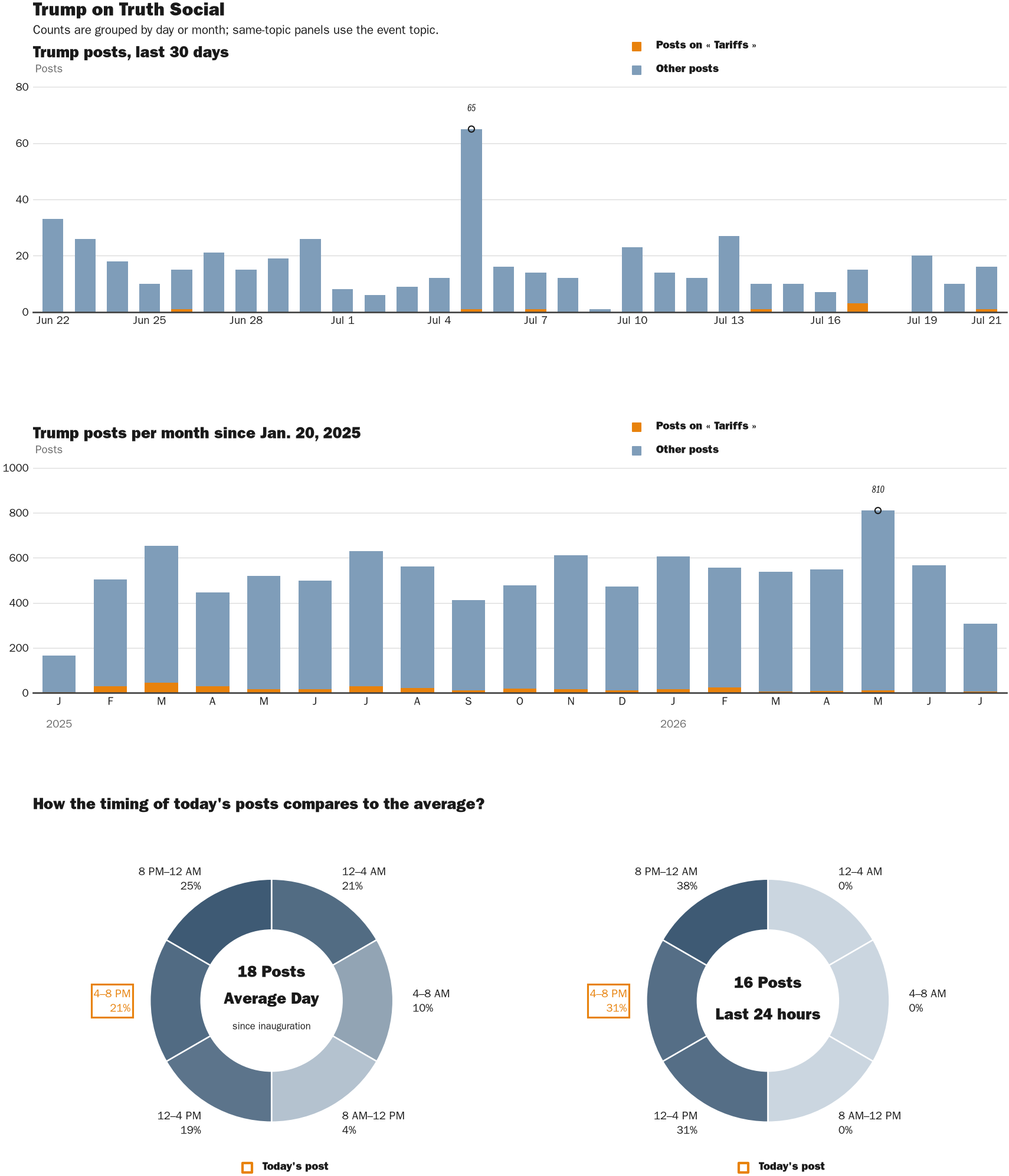
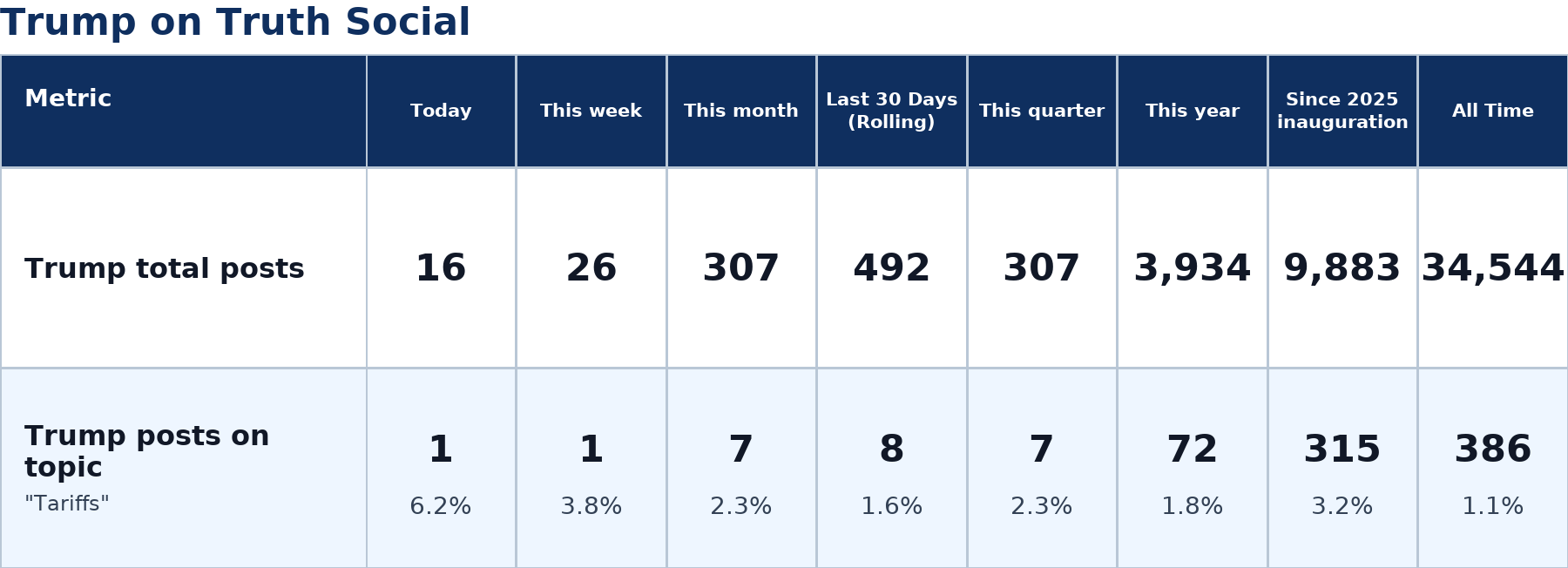
This is the first message released by Trump today. On average, Trump produces about 27 posts per day since his inauguration on January 20, 2025. The move fits a broader pattern in Trump’s recent messaging, with 8 of his 492 posts over the last 30 days focused on tariffs.
The stakes fall across two sets of players. Drugmakers that build domestic factories inside the two-year grace period avoid the penalty and stand to gain a protected market. Companies that keep production offshore face duties that eventually double the cost of their imported product, a burden that can flow to insurers, hospitals, and patients.
Generic medicines account for about 90% of prescriptions filled in the United States but a far smaller share of total drug spending, according to fda.gov. A large portion of the active ingredients and finished generics consumed domestically originate overseas, concentrated in a handful of countries, a dependency federal officials have flagged as a supply-chain risk.
For the average reader, the policy carries a direct link to the pharmacy counter. If manufacturers cannot stand up domestic capacity before the zero-tariff window closes, the cost of common medicines such as antibiotics and blood-pressure pills could rise, though the two-year runway is intended to blunt that outcome.
This has happened before in narrower forms. The administration has repeatedly used tariff threats to pull manufacturing back to the United States across autos, steel, and semiconductors, and it has previously signaled duties aimed at the drug sector. The generic-drug schedule extends that playbook with a defined penalty timeline.
The next decision rests with federal trade and health agencies that must implement the schedule and with the companies weighing whether to build. A firm date for any implementing rule beyond the stated August 1st, 2026 effective start has not been announced.
Washington has reached for tariffs to reshape trade before, as happened nearly a century ago. In June 1930, President Herbert Hoover signed the Smoot-Hawley Tariff Act, raising duties on more than 20,000 imported goods to protect American producers, according to britannica.com. Trading partners retaliated, U.S. imports and exports each fell by roughly two-thirds within a few years, and the measure is widely blamed for deepening the Great Depression. Hoover, who had championed the law as a shield for domestic industry, lost the White House in the 1932 election.

NewsFindr Chart Maker
Photo by Zenger real-time database of all Truth Social posts.
Zenger analysis
Photo by Zenger analysis