
Navy Cyber Deputy Kurtis A. Mole Nominated for Rear Admiral
The Department of War forwarded the nomination for Mole, deputy commander of Fleet Cyber Command at Fort Meade, Maryland, on July 16, 2026, one of 109 officer nominations announced this year.

Kurtis Mole, a Navy rear admiral serving in the lower half grade, was nominated for promotion to the full grade of rear admiral, the Department of War announced.
The nomination covers Mole’s appointment to the two-star rank and moves next to the Senate for confirmation, according to war.gov. Mole currently serves as deputy commander of Joint Forces Headquarters – Cyber (Navy) and deputy commander of Fleet Cyber Command at Fort Meade, Maryland. The two posts place him at the center of the Navy’s offensive and defensive cyber operations.
Fleet Cyber Command directs Navy networks, cryptology and space operations, while Joint Forces Headquarters – Cyber (Navy) supports combatant commanders with cyber effects. A promotion to rear admiral would confirm Mole’s standing among the service’s senior cyber leaders and expand the roles he can hold.
The announcement is one of 109 officer nominations announced so far this year, according to NewsFindr tracking data. Hawaii leads all states with 10 total nominations, while the Army carries the most among the military services with 74. At the same point in 2025, the database recorded only 26 officer nominations, a sign of a faster pace this year. The previous nomination announcement came 43 days earlier.
Senate confirmation determines whether a nominated officer pins on the higher rank. The chamber’s Armed Services Committee reviews flag and general officer nominations before the full Senate votes, a process that can move in batches. A date for a vote on Mole’s nomination has not been announced.
For most readers, the promotion signals where the Navy is placing its senior talent. Cyber commands defend the military networks that connect ships, aircraft and shore bases, and the leaders chosen for two-star billets shape how the service guards those systems against foreign intrusion.
Has this happened before? It has. The Navy routinely nominates rear admirals in the lower half for advancement to the full grade, and the Department of War publishes such nominations in periodic batches. Mole’s nomination follows the same path that hundreds of flag officers have taken, with the White House forwarding names to the Senate for advice and consent.
Namesakes and near-namesakes of the officer surface across public records unrelated to the nomination. A separate Kurtis was arrested in Manhattan, Kansas, on July 15, 2026, on municipal court warrants, according to rileycountypolice.org, a matter with no connection to the naval officer. The broadcast journalist Bill Kurtis, born William Kuretich in 1940, built a career at CBS and A&E, according to ksu.edu.
Senior officer promotions have long tracked the priorities of the moment, as happened before. During World War II, the Navy expanded its flag ranks sharply to command a fleet that grew to thousands of vessels, elevating officers who had spent the interwar years in obscure billets. The service commissioned carriers and escort ships faster than it could season commanders, and men promoted in wartime went on to run the postwar Navy. The cyber domain now draws the same institutional attention that gunnery and aviation once commanded.
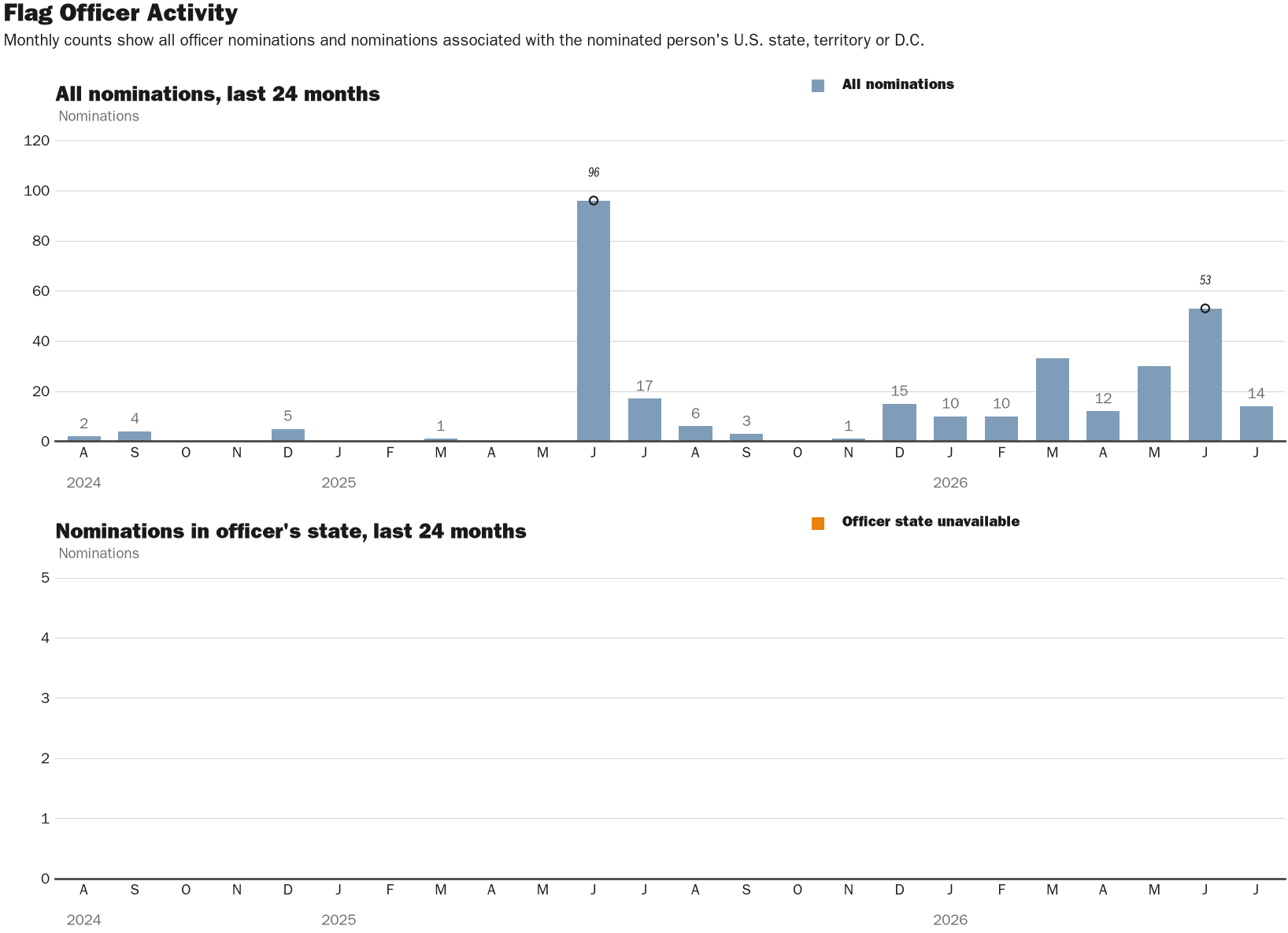

Source: NewsFindr Chart Maker
Note: Chart generated by NewsFindr on July 16, 2026 at 4:22 PM ET