Trump Declares Elections Rigged in Two-Word Truth Social Post
Trump revives fraud claims with a terse three-word message as election deniers shift their language from stolen to rigged ahead of the midterms.

WASHINGTON D.C. — Donald Trump escalated his long-running attack on the U.S. voting system with a two-word declaration that elections are rigged, posted to his Truth Social account without evidence or elaboration.
The message, which reached the platform’s tens of millions of followers, restated a grievance Trump has pressed since his 2020 defeat, offering no state, race, or data point to support the charge.
Here is the full post on Truth Social: “Rigged Elections!!!” on July 21, 2026 at 9:58 PM ET.
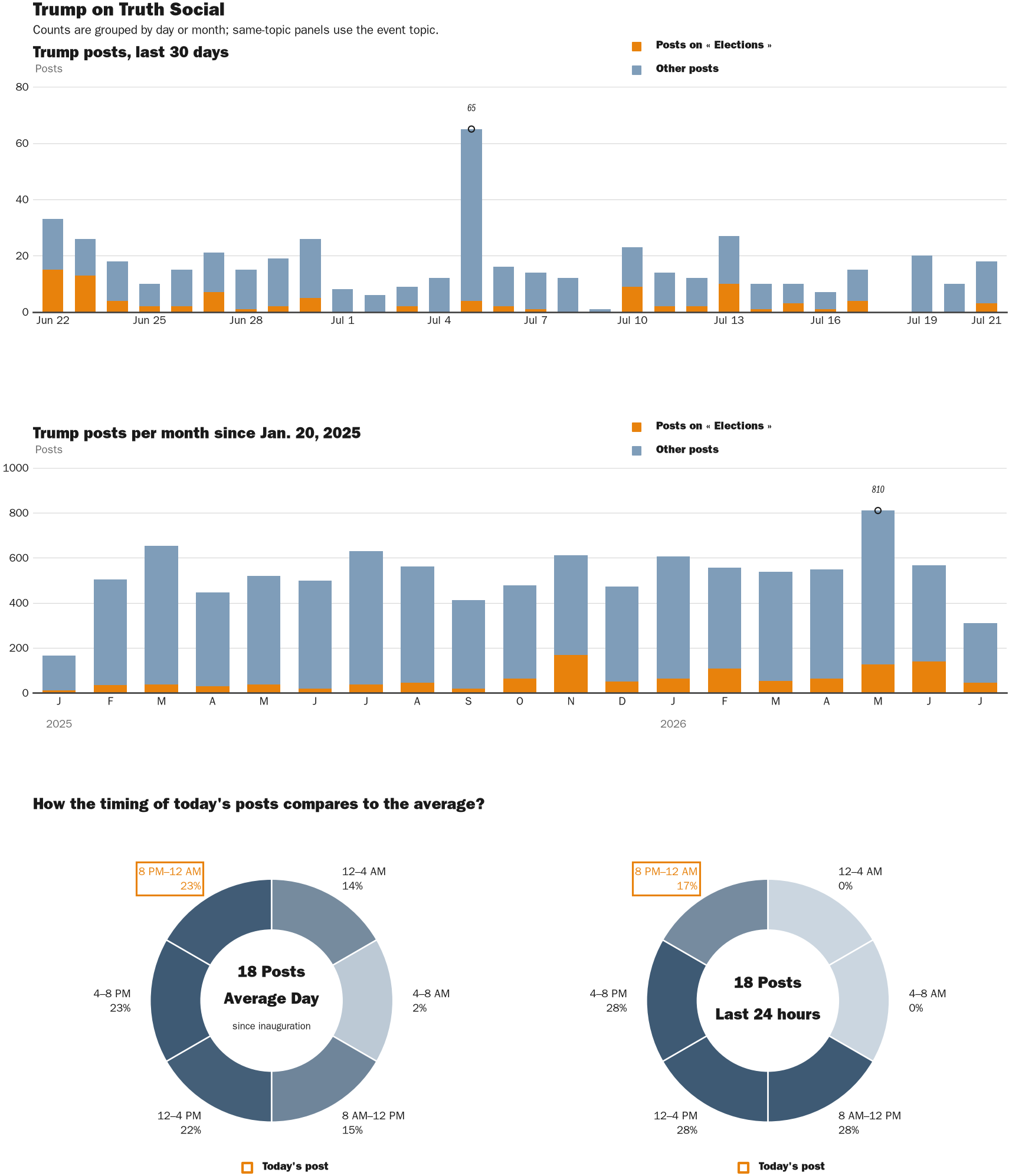
This is the latest message released by Trump today. On average, Trump produces about 16 posts per day since his inauguration on January 20, 2025.
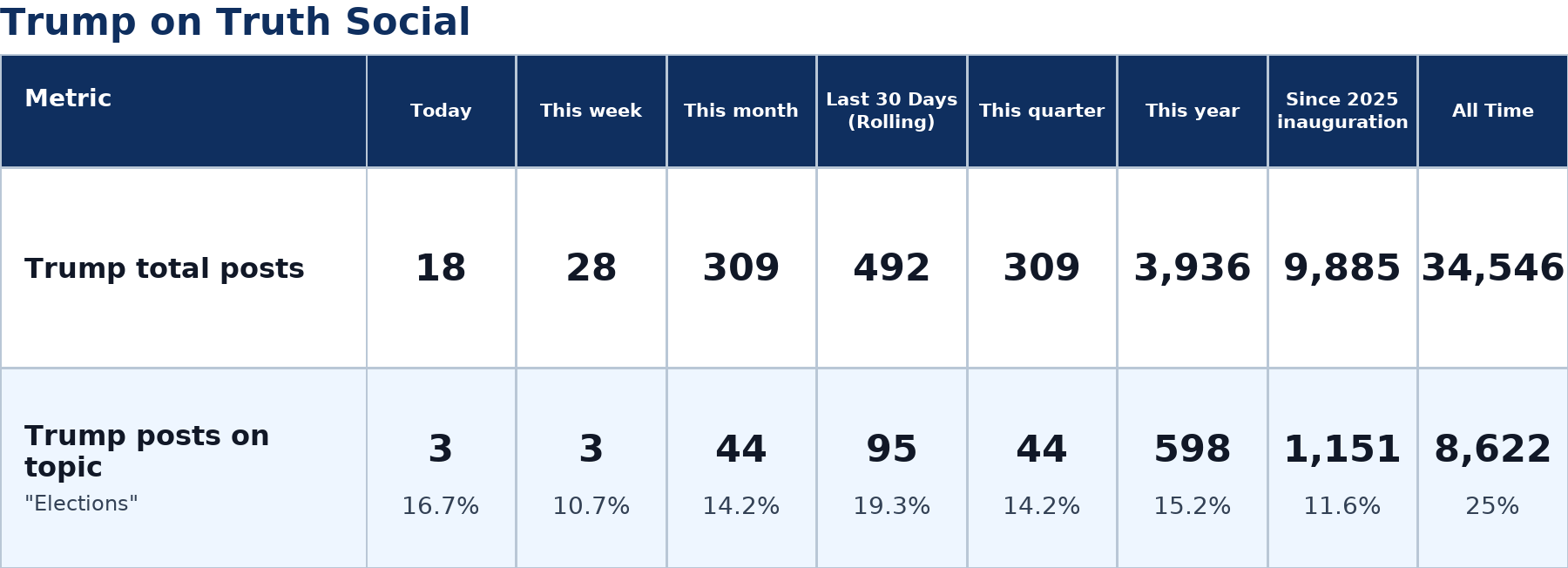
The move fits a broader pattern in Trump’s recent messaging, with 95 of his 492 posts over the last 30 days focused on elections, according to a Zenger analysis of Truth Social activity.
The wording marks a notable shift in the language of election denial. Prominent election deniers and far-right activists have moved away from claims that votes were “stolen” toward the argument that elections are “rigged” by lawful voting rules, according to democracydocket.com. Seth Keshel, an anti-voting activist who promoted Trump’s 2020 fraud claims, recently wrote that “elections are not stolen, but rather rigged” by state laws that allow expanded ballot counting, according to democracydocket.com.
The stakes reach beyond a single post. Voters who rely on mail ballots, automatic registration, and extended counting windows stand to lose the most if such rules are curtailed, while candidates who benefit from lower turnout stand to gain. The dispute centers on whether making voting easier is a civic good or an unfair advantage, a question that has divided the two major parties for decades.
The rhetorical pivot surfaced during California’s contentious primaries this cycle. Because California’s pro-voter rules allow days or weeks to count and cure ballots, close races took time to call, according to democracydocket.com. When Republican Spencer Pratt slipped to third place in the Los Angeles mayoral runoff as mail ballots were tallied, Trump wrote that the result was “not possible,” according to democracydocket.com. As more votes arrived and GOP candidate Steve Hilton clinched second place in the gubernatorial race, prominent Republicans backed away from fraud claims and instead criticized the state’s voting laws, according to democracydocket.com.
For the average reader, the debate shapes the mechanics of how and when they can cast a ballot. Restrictions on mail voting, registration, and counting deadlines would change the daily routine of voting for millions, from college students near campus polling places to workers who vote by mail around their shifts.
This has happened before. Trump made similar fraud claims after the 2020 election, telling reporters, “If you count the legal votes, I easily win,” according to democracydocket.com. Multiple courts and reviews found no evidence of widespread fraud, and the conspiracies nonetheless endured through the 2022 and 2024 election cycles, according to democracydocket.com.
The next decisions on U.S. election rules rest with state legislatures and courts, along with Congress on federal matters. A date for any specific ruling or legislative action tied to the claims in this post has not been announced.
Disputes over the fairness of American elections are as old as the republic. In the contested 1876 presidential race between Rutherford B. Hayes and Samuel Tilden, returns from three Southern states were disputed, and Congress created a 15-member Electoral Commission to settle the outcome, according to britannica.com. The commission awarded all 20 disputed electoral votes to Hayes, who won the presidency by a single electoral vote, 185 to 184, according to britannica.com. The bargain that followed ended Reconstruction, and the losing side carried its grievance over a “stolen” election for a generation.

NewsFindr Chart Maker
Photo by Zenger real-time database of all Truth Social posts.
Zenger analysis
Photo by Zenger analysis