
Trump Demands Senate Republicans Eliminate Filibuster to Pass Budget and Debt Ceiling
Trump calls on Republican senators to end the filibuster and pass the Save America Act, the federal budget, and a debt ceiling increase before time runs out.

WASHINGTON D.C. — Donald J. Trump, the 47th president of the United States, called on Republican senators to eliminate the Senate filibuster and pass a sweeping legislative package that includes the Save America Act, the federal budget, and a debt ceiling increase.
Here is the full post on truthsocial: “The all Republican Senators! Terminate the Filibuster, which the Dumocrats will do as soon as they get the chance, and PASS THE SAVE AMERICA ACT, and everything else, including the Budget, and upcoming Debt Ceiling. Do it now, before it is too late!!! President DJT” on July 25, 2026 at 11:48 PM ET.
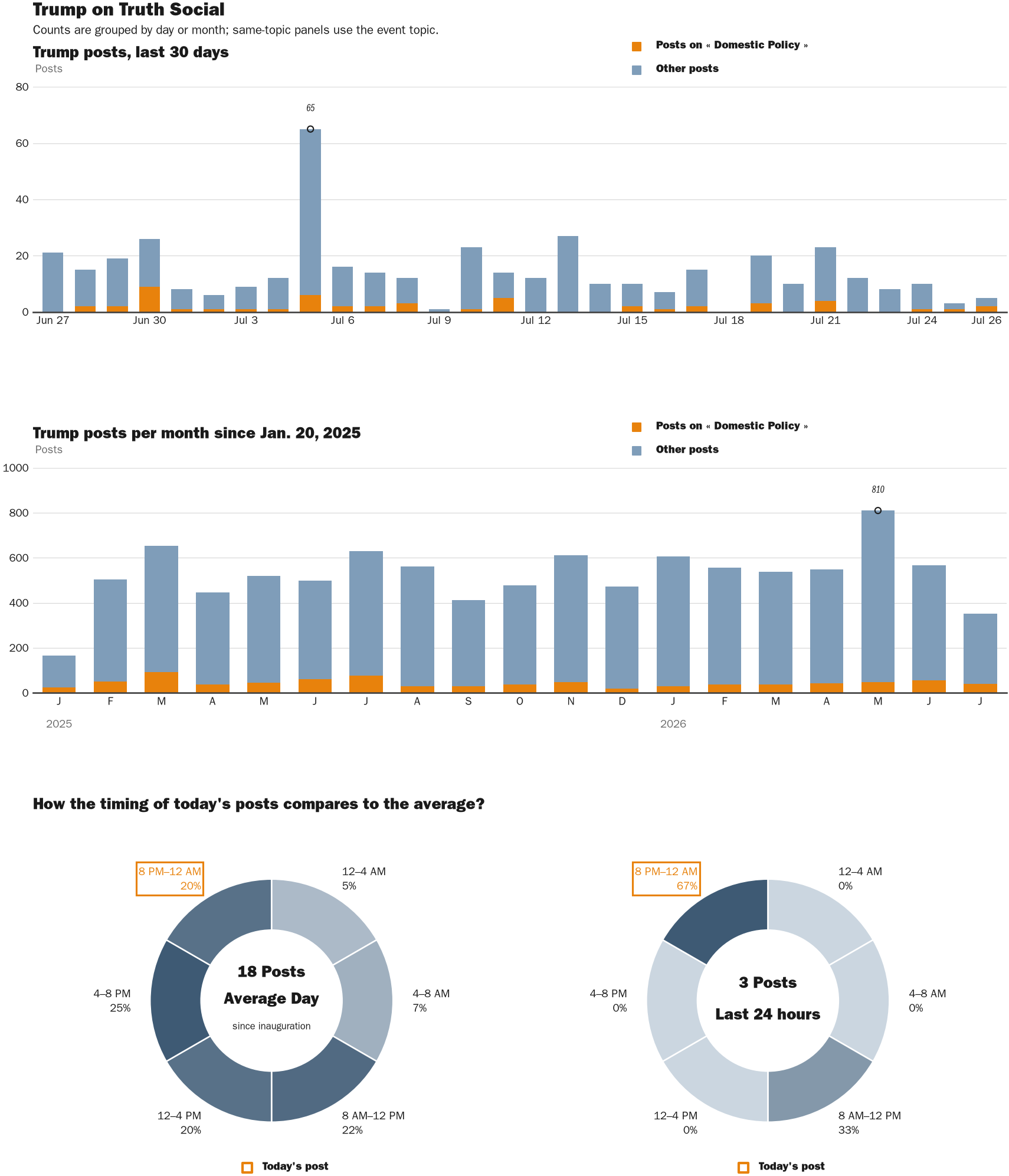
This is the first message released by Trump today. On average, Trump produces approximately 14.8 posts per day since his inauguration on January 20, 2025.
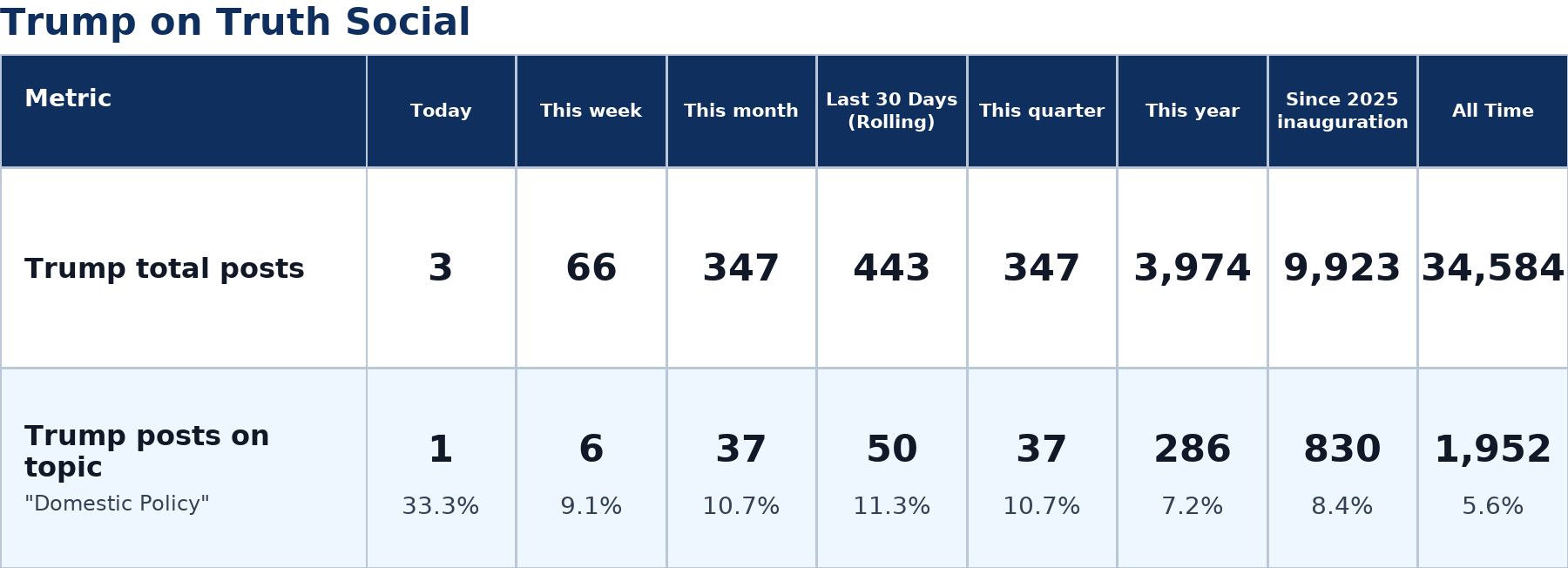
The post fits a broader pattern in Trump’s recent messaging, with 50 of his 443 posts over the last 30 days focused on domestic policy.
Republicans hold 53 seats in the 119th United States Senate — a majority, but short of the 60 votes required to overcome a filibuster on most legislation, according to senate.gov. Senate Majority Leader John Thune of South Dakota and Senate Majority Whip John Barrasso of Wyoming lead the Republican conference, according to senate.gov.
The filibuster is a procedural rule allowing senators to extend debate indefinitely, effectively requiring 60 votes to advance most bills to a final vote, according to senate.gov. Eliminating it for all legislation — sometimes called the “nuclear option” — would let the majority party pass bills with a simple 51-vote majority.
Trump’s demand places Senate Republicans in a difficult position. Ending the filibuster would give the current Republican majority broad legislative power, but it would also remove a tool Republicans could use to block Democratic legislation in future sessions when the party balance shifts.
The stakes are significant for ordinary Americans. The federal budget funds government operations, and a failure to raise the debt ceiling could trigger a default on U.S. obligations. Economists have warned such a default could disrupt financial markets, delay Social Security payments, and raise borrowing costs for consumers and businesses, according to brookings.edu.
Several Republican senators have historically opposed eliminating the filibuster, viewing it as a protection for the minority party and a check on majoritarian overreach, according to brookings.edu. Their resistance has been a recurring obstacle for presidents of both parties seeking to advance ambitious legislative agendas.
A sitting president publicly pressuring his own party’s senators to end the filibuster is not new. During his first term, Trump repeatedly called on Senate Republicans to eliminate the rule — including in 2017 and 2018, when the Senate failed to repeal the Affordable Care Act and pass other priority legislation. Then-Senate Majority Leader Mitch McConnell of Kentucky refused each time, and the filibuster remained intact, leaving the 60-vote threshold in place for all major legislation.
The next decision rests with the Senate Republican conference, led by Majority Leader Thune. No date has been announced for a vote on either the filibuster rule change or the underlying legislative package Trump cited in his post.
Filibuster fights have reshaped American governance before. In November 2013, then-Senate Majority Leader Harry Reid of Nevada invoked the nuclear option to eliminate the filibuster for executive branch nominations and lower federal court appointments, passing the change with 52 votes. Republicans, then in the minority, warned the move would be turned against them. In April 2017, Senate Republicans under Majority Leader McConnell extended the nuclear option to Supreme Court nominations to confirm Justice Neil Gorsuch after Democrats filibustered his confirmation. Each time the rule changed, the majority that changed it later found itself in the minority, facing a Senate floor it had made more permissive for its opponents.

NewsFindr Chart Maker
Photo by Zenger real-time database of all Truth Social posts.
Zenger analysis
Photo by Zenger analysis