Digital Euro advances while ECB can’t cite a legal basis for it
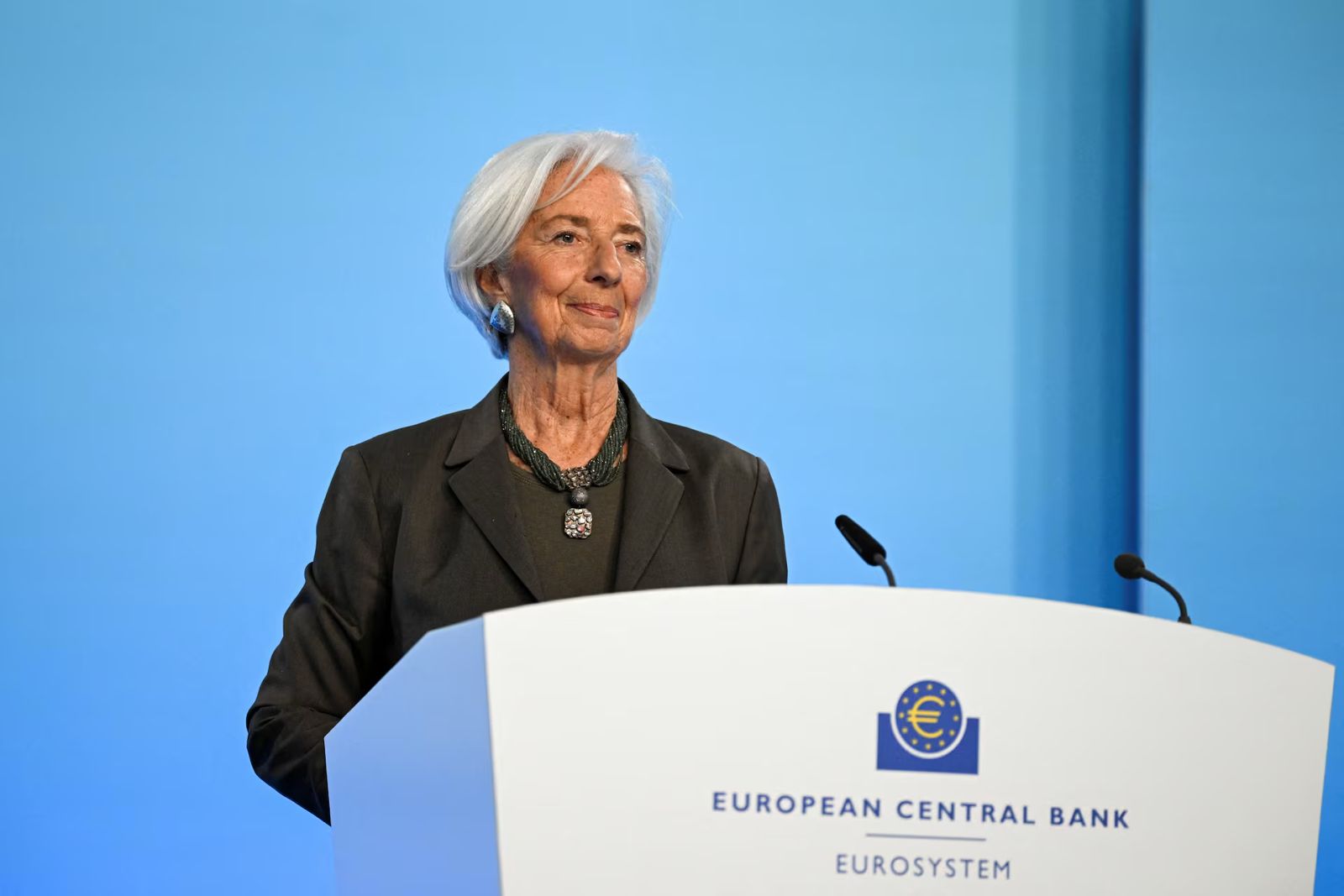
EU President Christine Lagarde says a digital euro would free Europe from U.S. payment rails. It would run on iPhones.

COMPIèGNE, FRANCE — The European Central Bank is building a new form of money that is digital, state-issued, and available to all 350 million Europeans. Critics say it could, in theory, be switched off to punish dissidents or minorities. Supporters say those fears are unfounded. Both sides agree on one thing: It is coming.What neither side has been asked to explain publicly is whether the ECB has the legal authority to do it.In October 2025, this reporter stood up at a conference at the European Parliament and put that question directly to Piero Cippolone — the ECB Executive Board member personally responsible for the digital euro project. His answer is on YouTube, at 46 minutes and 15 seconds of a conference that had attracted fewer than 200 views at the time of writing:
“So, in terms of the, the, in terms of the legal basis for the issuance of the digital euro, I am not an expert, but obviously the, the, the, the the legal, the legal services of the commission, of the council, and the ECB and worked pretty closely to that. And under, I guess, is article 133, but I might be wrong. I don't remember now by heart, is a legal, is a, has been recognized as a legal base for the ECB to issue to issue the digital euro. So, the, the legal base seems to be pretty robust.”
This was not a trick question. Article 133 of the Treaty on the Functioning of the European Union is the legal provision the European Commission chose as the foundation for the entire digital euro project. It authorizes the European Parliament and the Council to lay down measures for the use of the existing euro — the currency that already exists, in your wallet or in your bank account. Whether it also authorizes the creation of a third form of central bank money, distinct from banknotes and reserves, is a genuinely contested legal question. Cipollone’s answer confirmed that even the man running the project wasn’t certain.
That answer went almost entirely unnoticed. Despite the significance of the proposal, its final consideration in plenary before Parliament confirmed the negotiating mandate was remarkably brief. Nine months after Cipollone’s admission, the European Parliament voted 416 to 169 to authorize the final round of negotiations on the digital euro regulation — without its own Legal Service ever having been asked to examine the question.ECB President Christine Lagarde went on Euronews on July 9, 2026, to celebrate the vote and explain why Europe needed the project. Her argument, the one heard most often from the digital euro’s supporters, was sovereignty:
“The best thing I know is a European solution. At the moment, we do not have that. So if you pay in most instances, 60% of the cases, you use payment infrastructure that is under foreign capital. So we depend on predominantly US but also sometimes China networks to organize payments. We need to have a European solution because we want to be sovereign at home.”
Patrick Schueffel has spent years studying central bank digital currencies. He is one of Europe’s leading academic experts on the subject, with published research on the structural differences between cash and programmable money, and has been a consistent critic of the digital euro project’s design. For this article, this reporter put Lagarde’s sovereignty argument to him directly. His response cut to something the official discourse tends to avoid:
“Um, a a nice one is how it will strengthen the sovereignty of of Europe. Okay, fair enough. Uh, maybe if you took look at maybe Mastercard and Visa card, but but that then that's more a matter of of money making, who makes the money, where where does it end up? But about technical sovereignty, the digital Euro will not help at all because we will have it on handhelds that run on iOS, that run on Android, um, all the layers at at uh, at vendors are either US dominated or China dominated, let it be in ownership or let it be the hardware, let it be the software. So whenever you use the digital Euro, there will be in this chain an American player that is that can be controlled from the US. So if at all compared to cash, you increase the dependence of Europeans on the US and China by introducing this new digital money. You don't reduce it. Again, an argument that is absurd if you look at the details of it.”
The distinction Schueffel draws matters. Cash — banknotes — already delivers monetary sovereignty: issued by the ECB, accepted everywhere, requiring no foreign technology to change hands. Lagarde is arguing that the digital euro would extend that monetary sovereignty into the digital realm. Schueffel’s point is that it cannot, because the digital realm itself runs on American and Chinese infrastructure. A digital euro that runs on an iPhone, processed through American cloud servers, does not reduce European dependence on American technology. It digitizes it.
Lagarde also advanced a second argument — closely related to the first. Europe’s private sector, she suggested, had failed to produce a European payments solution, leaving a market gap the ECB was now obliged to fill. This reporter asked Schueffel about that too:
“Another argument is we see we see a market a market need that is not filled by private players and therefore the the government has to step in and introduce the digital Euro. Most notably the the head of the German Bundesbank said that but yet again we have we have Vero as a system. We have soon a European stable coin launched by 10 European banks. So more and most likely Vero is already existing now the stable coin will be live most likely before the digital Euro. So there are private alternatives. There is no market failure. That is not an argument for the digital Euro um let alone for a retail CBDC. Um simply simply not the case.”
Wero launched in 2024. By early 2026, it had 43.5 million registered users across France, Germany, Belgium, and the Netherlands, processing more than €7.5 billion in transfers. In May 2026, it signed an interoperability agreement with four other national payment systems — Bancomat, Bizum, MB WAY, and Vipps MobilePay — bringing combined reach to roughly 130 million users across 13 European countries. It is in the process of absorbing iDEAL, the Netherlands’ dominant national payment system. Its privacy terms are governed by existing EU banking and data protection law — not by delegated Commission authority to revise them without Parliament. A European stablecoin backed by a consortium of ten European banks is in development, expected to reach users before the digital euro’s projected 2029 launch.
The market failure the ECB was summoned to correct had already been corrected. Yet few in France appear to have noticed — or been told.
Frédéric-Pierre Vos, a member of the French National Assembly for the Oise constituency, sees that silence as itself a warning:
“L'Union européenne a construit l'Europe monétaire, mais elle n'a pas construit l'Europe financière et fiscale. Et pourtant, derrière notre dos, les fonctionnaires européens aux ordres d'Ursula von der Leyen sont en train de préparer une révolution. Elle consiste à faire adopter par le Parlement européen des dispositions concernant l'euro numérique. Mais vous constaterez que l'euro numérique est totalement absent du débat public français et que nous allons nous trouver bientôt confrontés à toute la ta de mesure engendrant un nombre de problèmes à cause de cette euro numérique qui va frapper les commerçants, les petites entreprises et tout à chacun. Par ailleurs, nous allons devoir depuis le 1er septembre dernier passer également à la facturation numérique. Tout ceci aura été fait par des gens non élus et sans que la démocratie ait pu s'exprimer.”
The ECB’s own Consumer Expectations Survey found that only 18 percent of Europeans would spontaneously adopt the digital euro, with privacy cited as the primary concern among those who would not.
The Legal Question Nobody Asked
Before the Commission even filed its proposal, Parliament’s Economic and Monetary Affairs Committee had commissioned a legal analysis of the digital euro’s Treaty foundations. The study, written by legal scholar Seraina Grünewald and published in May 2023 — a month before the Commission presented its proposal — reached a conclusion that has not been widely quoted: “The choice of legal basis for the digital euro is thus prima facie not clear cut.” She identified Articles 127(2) and 128 TFEU, plus Articles 17 and 22 of the ESCB/ECB Statute, as more appropriate legal foundations for the project’s core elements. She went further: “An express Treaty provision empowering the ECB to issue a digital euro would clearly be the first-best solution” and “a Treaty amendment should be the preferred course of action in the longer term.” The same study warned that any legal construction assembled from existing Treaty provisions “might be tested in court and thus comes with certain legal and reputational risks.”
Grünewald acknowledged that Article 133 could serve as a basis for co-legislators to “recognise” the digital euro and integrate it into the EU legal framework. But she drew a critical distinction: the Commission’s proposal goes far beyond mere recognition, determining the digital euro’s core design, holding limits, privacy architecture, and distribution structure. Whether Article 133 is sufficient for a regulation of this scope and depth — rather than a minimal enabling framework — is precisely what no independent body has examined.
This was not an opinion from Parliament’s Legal Service — the institution whose institutional job is to formally validate Treaty bases before Parliament votes. Grünewald’s study was an external academic analysis, commissioned by ECON, carrying an explicit disclaimer that its conclusions did not represent the official position of the European Parliament. Parliament’s own Legal Service was never asked to examine the question. Under Parliament’s Rules of Procedure, any political group may formally request such an opinion at any time. Parliament’s official document register, searched for this procedure (2023/0212(COD)), returns no such document.
Parliament voted on a mandate whose legal foundation its own legal institution had never reviewed.
Dissenting lawyers identify three independent grounds on which the regulation could be challenged before the Court of Justice of the EU. The wrong Treaty base —Article 133authorizes measures for the use of the existing euro, not the creation of a new form of it. An absent dual legal basis — the regulation mandates structural interoperability with the European Digital Identity Wallet, an instrument rooted in a different Treaty article, and established case law holds that when two distinct Treaty competences are inseparably engaged, both must be acknowledged. And a delegation too broad to stand — the Commission can rewrite the regulation’s privacy thresholds, holding limits, and remuneration conditions without returning to Parliament, with silence at renewal counting as consent.
The privacy point deserves a moment. The regulation describes digital euro transactions as pseudonymised. A 2015 study published in Science by Yves-Alexandre de Montjoye and colleagues at MIT found that just four spatiotemporal data points were sufficient to re-identify 90 percent of individuals from pseudonymised transaction records. Pseudonymisation in the current text is the floor. The Commission can revise it — by delegated act, without Parliament voting. It is a promise written in pencil.
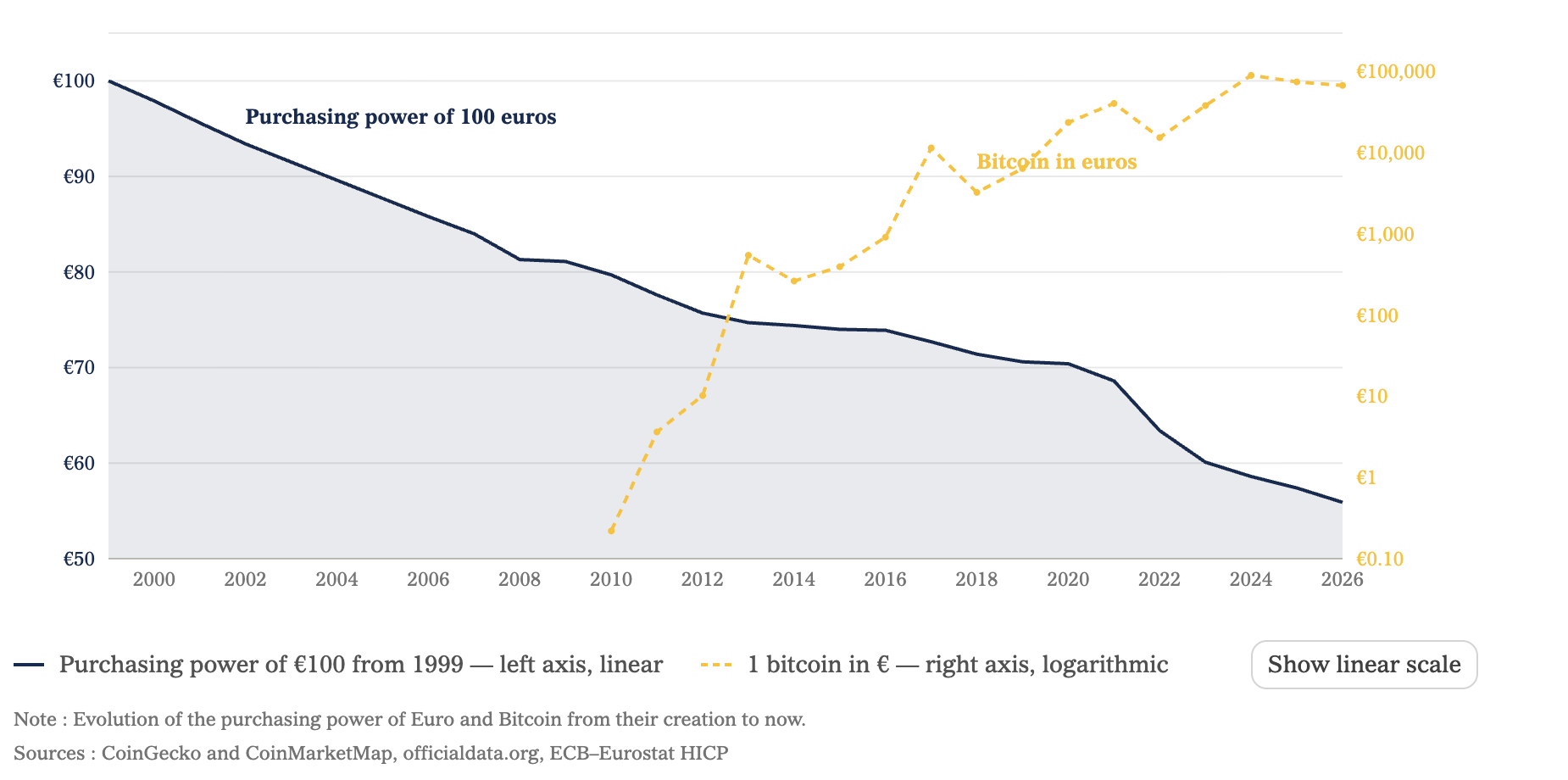

Evolution of the purchasing power of Euro and Bitcoin from their creation in to now on October 4, 2026 at 3:35 PM
One Week. Two Answers.
The week of June 22, 2026 produced a natural experiment in how democracies make decisions about money.
On June 22, the United States Senate voted 85 to 5 to pass the 21st Century ROAD to Housing Act — a sweeping bipartisan housing package that, among its many provisions, included a statutory prohibition on the Federal Reserve issuing or creating a central bank digital currency through December 31, 2030. The same legislation had passed the Senate by 89 votes to 10 on March 12. The overwhelming votes should not be read as standalone referenda on CBDCs: senators voted for a broad package of major housing reforms.
Nevertheless, the result was unambiguous — one day before Europe’s ECON Committee backed the digital euro, the U.S. Senate had approved legislation restricting the Federal Reserve from creating one.
Donald Trump had made his position plain at a campaign rally in Portsmouth, New Hampshire, in January 2024:
“Tonight, I’m also making another promise to protect Americans from government tyranny. As your president, I will never allow the creation of a Central Bank Digital Currency. Such a currency would give a federal government, our federal government, the absolute control over your money. They could take your money — you wouldn’t even know it was gone. This would be a dangerous threat to freedom.”
He signed an executive order to that effect on January 23, 2025. On June 23 — the day after the Senate vote — the European Parliament’s ECON Committee voted 43 to 14 to proceed. On July 9, Parliament confirmed that mandate 416 to 169.
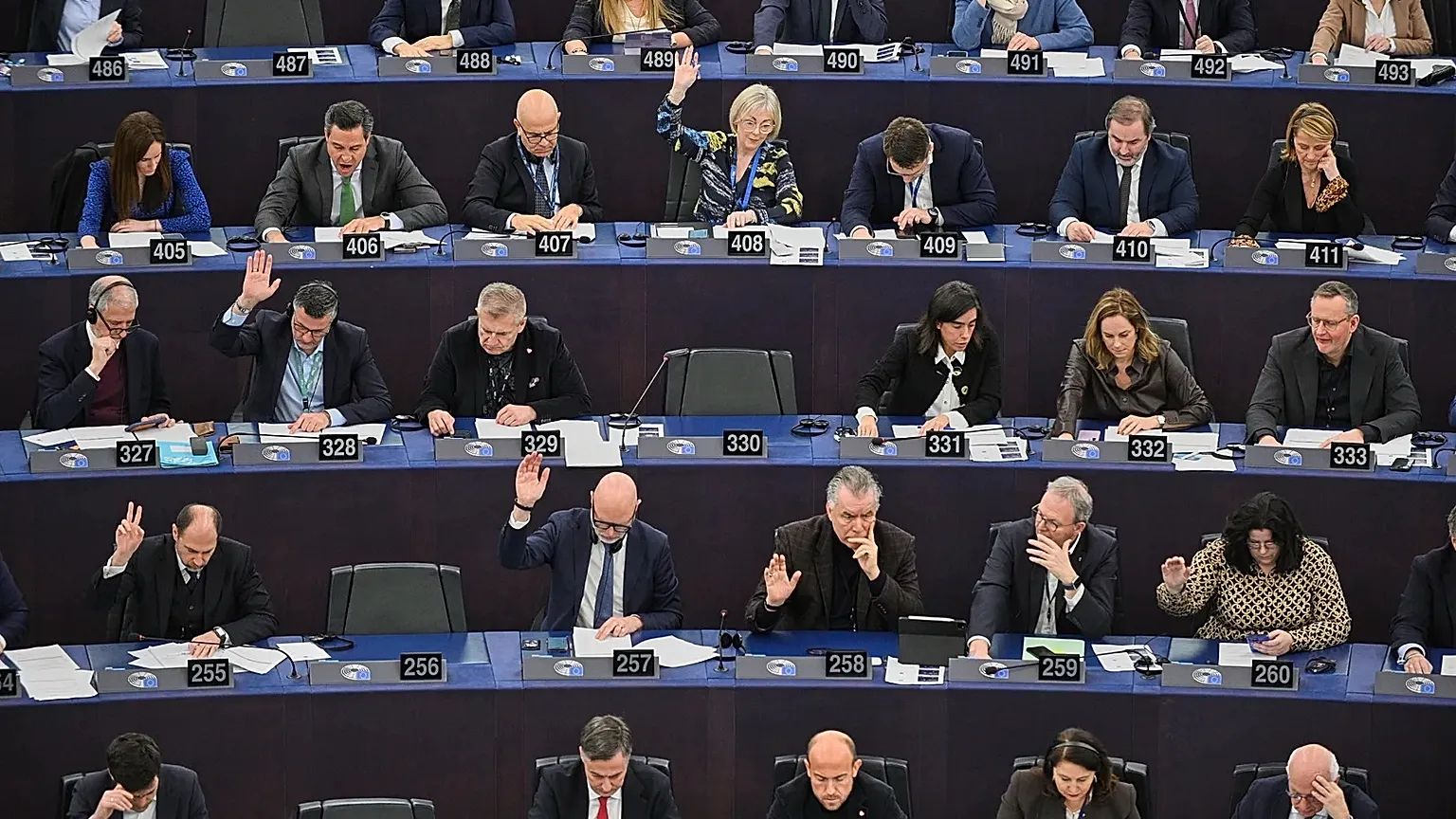
Members of the European Parliament vote by show of hands during in a plenary session at the European Parliament on July 9, 2026 at 6:55 PM. Parliament confirmed the digital euro's negotiating mandate that day, 416 votes to 169.. Photo: Pascal Bastien/AP. © @2026 AP
On August 19, Donald Trump hosted at the White House the CEOs of Ripple (XRP), Coinbase, Robinhood, and Kraken — alongside Nasdaq CEO Adena Friedman and the chairs of the SEC and CFTC — to advance legislation clarifying the rules for private digital assets. Trump was direct: “We’re ensuring that America remains the undisputed leader, not only in Bitcoin and crypto but also technologies like prediction markets, artificial intelligence, and much more.”
Not a central bank in the room. The American model for digital monetary innovation is private, competitive, and market-driven. The European model is a state monopoly built by an institution whose own official could not confirm its legal authority to exist.
Two Western democracies. The same question. Opposite answers.
The Record That Now Exists
A trilogue is an informal three-way negotiation between the European Parliament, the European Commission, and the Council of the EU — the body representing member state governments — to hammer out the final text of a piece of legislation. Once that text is agreed and published in the Official Journal of the European Union — the EU’s equivalent of the Federal Register — Article 263 of the Treaty gives any EU Member State a two-month window to bring an annulment action before the Court of Justice on grounds of institutional incompetence. The trilogue on the digital euro is expected to conclude sometime in 2027.
The record that will be available to any such challenge includes: an ECB official saying on camera that he was not sure his institution had the Treaty authority for what it was doing; a Parliament that voted to proceed without asking its own Legal Service to examine the question; a legal analysis commissioned by Parliament’s own committee that had flagged the risks in writing a month before the Commission even filed its proposal; and a month in which the world’s largest economy moved deliberately in the opposite direction.
The man who built it wasn’t sure he had the right. The people who authorized it didn’t ask. The people it was built for didn’t ask for it.
MEP Angéline Furet, who voted against the mandate in the European Parliament, offers a verdict that is difficult to dismiss:
“The European Central Bank is imposing its digital Euro without a single independent body having validated its legal basis. Worse still, our privacy guarantees could be wiped out by simple administrative acts without a single vote in our parliaments. While Donald Trump's America chooses financial freedom by securing Bitcoin, Brussels is building a centralized state infrastructure. Under the guise of innovation, the European Union is sacrificing our liberties to impose a soft version of the Chinese surveillance model.”
The clock starts in 2027.